Datasheet4U Logo Datasheet4U.com

VENUS634FLPx - 65 Channel Low Power GPS Receiver

Description

Active LOW reset input, 3.3V LVTTL Main voltage supply input, 2.8V ~ 3.6V Not connected, empty pin General purpose I/O pin, 3.3V LVTTL General purpose I/O pin, 3.3V LVTTL General purpose I/O pin, 3.3V LVTTL Navigation status indicator or General purpose I/O.

3.3V LVTTL General purpose I/O pin.

Features

  • z z z z z z z z z z z z z GPS receiver in 10mm x 10mm x 1.1mm size Tests 8 million time-frequency hypothesis per sec Open sky cold start 29 second Signal detection better than -161dBm Accuracy 2.5m CEP ~28mA in tracking and navigation mode Multipath detection and suppression Data logging with external SPI serial Flash Supports active or passive antenna 1 SPI interface and 7 GPIO lines Flash-based, firmware customizable LGA44 package with 0.8 pitch Pb free RoHS compliant The Venus634FLPx is a mo.

📥 Download Datasheet

Datasheet preview – VENUS634FLPx

Datasheet Details

Part number VENUS634FLPx
Manufacturer SkyTraq
File Size 236.77 KB
Description 65 Channel Low Power GPS Receiver
Datasheet download datasheet VENUS634FLPx Datasheet
Additional preview pages of the VENUS634FLPx datasheet.
Other Datasheets by SkyTraq

Full PDF Text Transcription

Click to expand full text
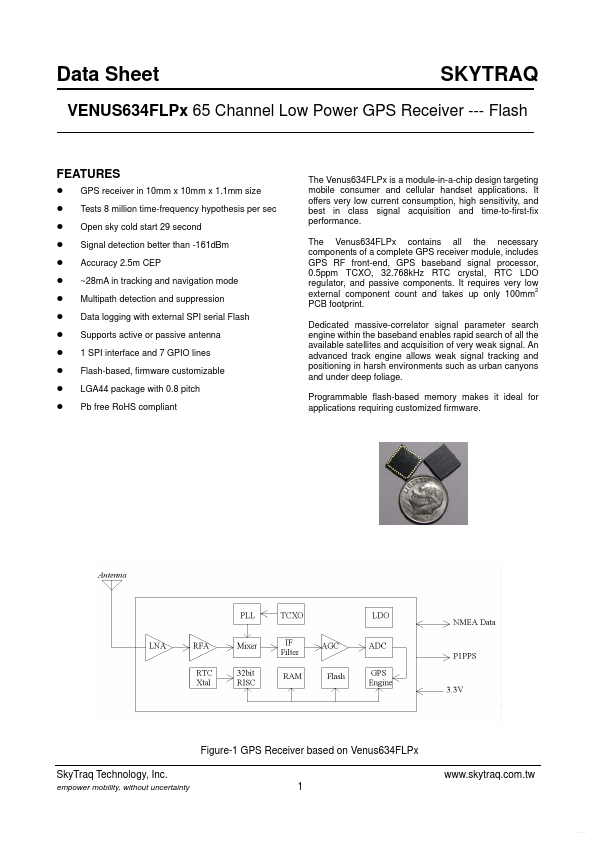
Data Sheet SKYTRAQ VENUS634FLPx 65 Channel Low Power GPS Receiver --- Flash FEATURES z z z z z z z z z z z z z GPS receiver in 10mm x 10mm x 1.1mm size Tests 8 million time-frequency hypothesis per sec Open sky cold start 29 second Signal detection better than -161dBm Accuracy 2.5m CEP ~28mA in tracking and navigation mode Multipath detection and suppression Data logging with external SPI serial Flash Supports active or passive antenna 1 SPI interface and 7 GPIO lines Flash-based, firmware customizable LGA44 package with 0.8 pitch Pb free RoHS compliant The Venus634FLPx is a module-in-a-chip design targeting mobile consumer and cellular handset applications. It offers very low current consumption, high sensitivity, and best in class signal acquisition and time-to-first-fix performance.
Published: |