
Datasheet4U Logo Datasheet4U.com

Si53305 - Ultra-Low Additive Jitter Fanout Clock Buffers

Download the Si53305 datasheet PDF. This datasheet also covers the Si53301 variant, as both devices belong to the same ultra-low additive jitter fanout clock buffers family and are provided as variant models within a single manufacturer datasheet.

Description

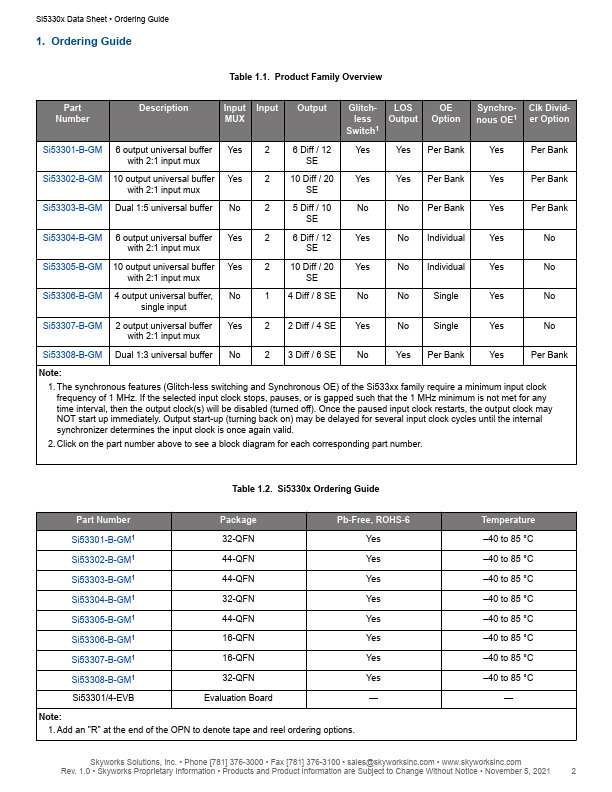
Input Input MUX Output Glitch- LOS less Output Switch1 OE Option Synchro- Clk Dividnous OE1 er Option Si53301-B-GM 6 output universal buffer Yes 2 6 Diff / 12 Yes with 2:1 input mux SE Yes Per Bank Yes Per Bank Si53302-B-GM 10 output universal buffer Yes 2 10 Diff / 20 Yes with 2:1

Features

  • include independent (synchronous) output enable, glitchless switching, LOS monitor of input clocks, output clock division, and built-in format translation. These buffers can be paired with the Si534x clocks and jitter attenuators, the Si5332 clocks, and the Si5xx oscillators to deliver end-to-end clock tree performance. KEY.

📥 Download Datasheet

Note: The manufacturer provides a single datasheet file (Si53301-Skyworks.pdf) that lists specifications for multiple related part numbers.

Datasheet Details

Part number Si53305
Manufacturer Skyworks
File Size 1.12 MB
Description Ultra-Low Additive Jitter Fanout Clock Buffers
Datasheet download datasheet Si53305 Datasheet

Full PDF Text Transcription

Click to expand full text
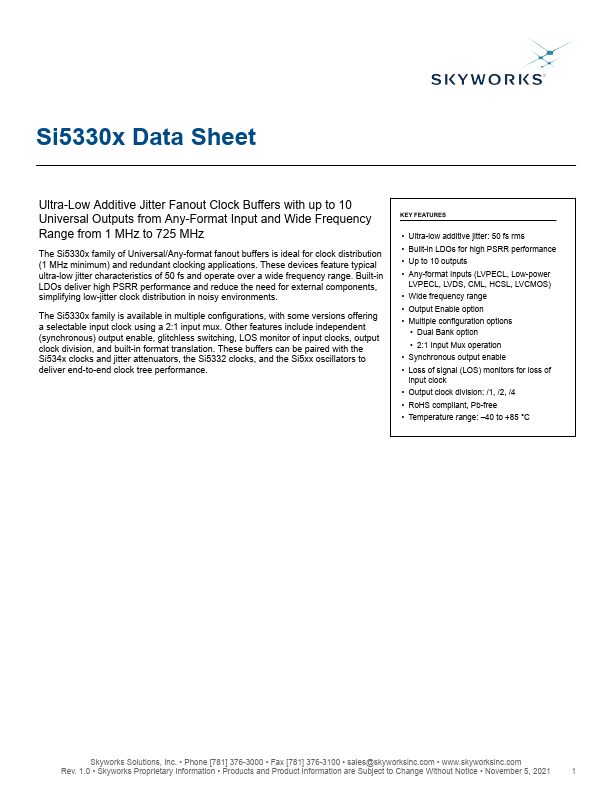
Si5330x Data Sheet Ultra-Low Additive Jitter Fanout Clock Buffers with up to 10 Universal Outputs from Any-Format Input and Wide Frequency Range from 1 MHz to 725 MHz The Si5330x family of Universal/Any-format fanout buffers is ideal for clock distribution (1 MHz minimum) and redundant clocking applications. These devices feature typical ultra-low jitter characteristics of 50 fs and operate over a wide frequency range. Built-in LDOs deliver high PSRR performance and reduce the need for external components, simplifying low-jitter clock distribution in noisy environments. The Si5330x family is available in multiple configurations, with some versions offering a selectable input clock using a 2:1 input mux.
Published: |