CXP85200A
Key Features
- Instruction set which supports a wide array of data types - 213 types of instructions which include 16-bit calculations, multiplication and division arithmetic, and boolean bit operations.
- Minimum instruction cycle 1µs/4MHz
- EPROM 27C256 LCC type 27C256
- Incorporated RAM capacity 448 bytes
- EPROM for custom font (CXP85290A only) LCC type 27C256 (used volume is 4K bytes)
- Peripheral functions - On-screen display function 12 × 16 dots, 128 types, 8 colors, 21 characters × 4 lines (More than 5 lines possible) Double scanning mode, jitter elimination circuit - I2C bus interface - PWM output 14 bits, 1 channel 6 bits, 8 channels - Remote control receiving circuit 8-bit pulse measurement counter, 6-stage FIFO - A/D converter 4 bits, 4 channels, successive approximation system (conversion time of 40µs/4MHz) - HSYNC counter - Power supply frequency counter - Watchdog timer - Serial I/O 8-bit clock synchronized - Timers 8-bit timer, 8-bit timer/counter, 19-bit time-base timer
- Interrupts 14 factors, 14 vectors multi-interruption possible
- Standby mode Sleep
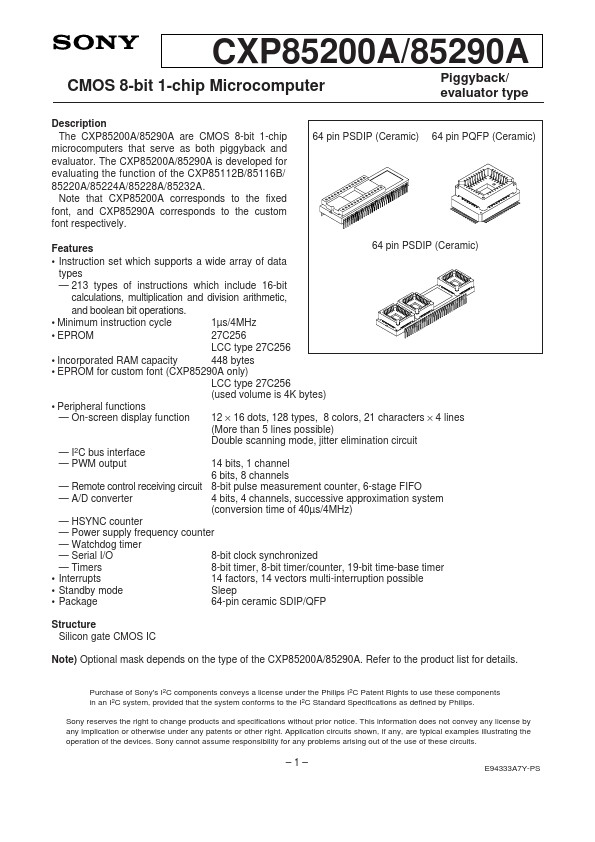
- Package 64-pin ceramic SDIP/QFP Structure Silicon gate CMOS IC Note) Optional mask depends on the type of the CXP85200A/85290A. Refer to the product list for details. Purchase of Sony's I2C components conveys a license under the Philips I2C Patent Rights to use these components in an I2C system, provided that the system conforms to the I2C Standard Specifications as defined by Philips. Sony reserves the right to change products and specifications without prior notice. This information does not convey any license by any implication or otherwise under any patents or other right. Application circuits shown, if any, are typical examples illustrating the operation of the devices. Sony cannot assume responsibility for any problems arising out of the use of these circuits. -1-