FS310
FS310 is Programmable Incremental Encoder manufactured by TT Electronics.
Description
:
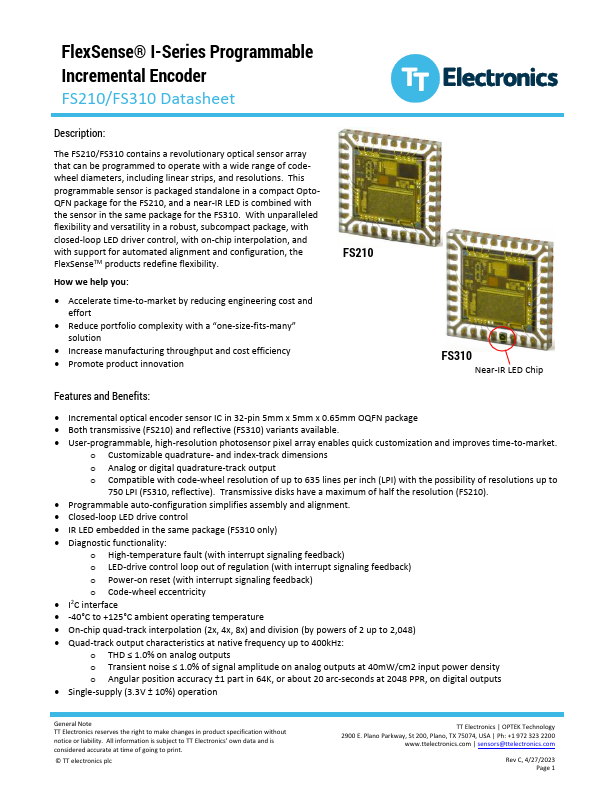
The FS210/FS310 contains a revolutionary optical sensor array that can be programmed to operate with a wide range of codewheel diameters, including linear strips, and resolutions. This programmable sensor is packaged standalone in a pact Opto QFN package for the FS210, and a near-IR LED is bined with the sensor in the same package for the FS310. With unparalleled flexibility and versatility in a robust, subpact package, with closed-loop LED driver control, with on-chip interpolation, and with support for automated alignment and configuration, the Flex Sense TM products redefine flexibility.
How we help you:
- Accelerate time-to-market by reducing engineering cost and effort
- Reduce portfolio plexity with a “one-size-fits-many” solution
- Increase manufacturing throughput and cost efficiency
- Promote product innovation
FS210
Near-IR LED Chip
Features and Benefits:
- Incremental optical encoder sensor IC in 32-pin 5mm x 5mm x 0.65mm OQFN package
- Both transmissive (FS210) and reflective (FS310) variants available.
- User-programmable, high-resolution photosensor pixel array enables quick customization and improves time-to-market. o Customizable quadrature- and index-track dimensions o Analog or digital quadrature-track output o patible with code-wheel resolution of up to 635 lines per inch (LPI) with the possibility of resolutions up to
750 LPI (FS310, reflective). Transmissive disks have a maximum of half the resolution (FS210).
- Programmable auto-configuration simplifies assembly and alignment.
- Closed-loop LED drive control
- IR LED embedded in the same package (FS310 only)
- Diagnostic functionality: o High-temperature fault (with interrupt signaling feedback) o LED-drive control loop out of regulation (with interrupt signaling feedback) o Power-on reset (with interrupt signaling feedback) o Code-wheel eccentricity
- I2C interface
- -40°C to +125°C ambient operating temperature
- On-chip quad-track interpolation (2x, 4x, 8x) and division...