Datasheet4U Logo Datasheet4U.com

XC9271 - 30V Driver Transistor Built-In Step-Down DC/DC Converters

This page provides the datasheet information for the XC9271, a member of the XC9270 30V Driver Transistor Built-In Step-Down DC/DC Converters family.

Description

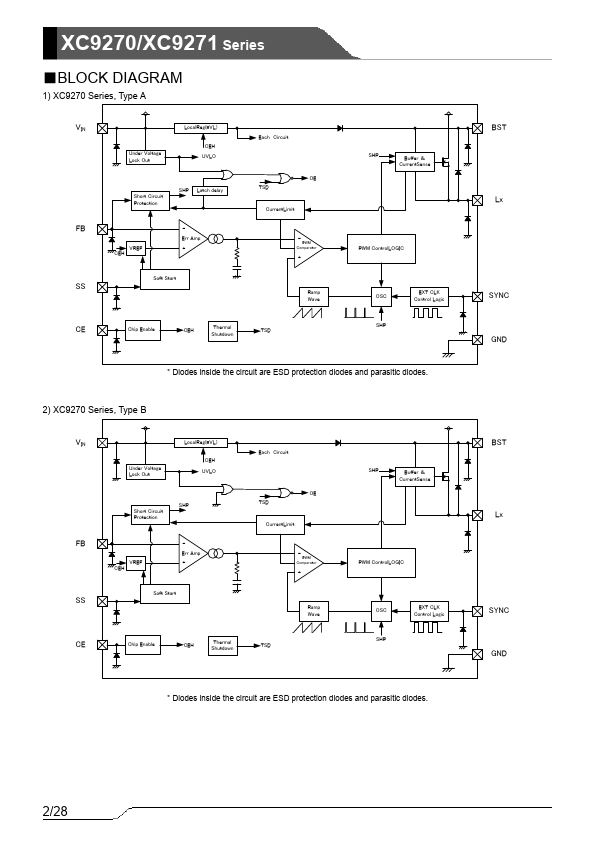
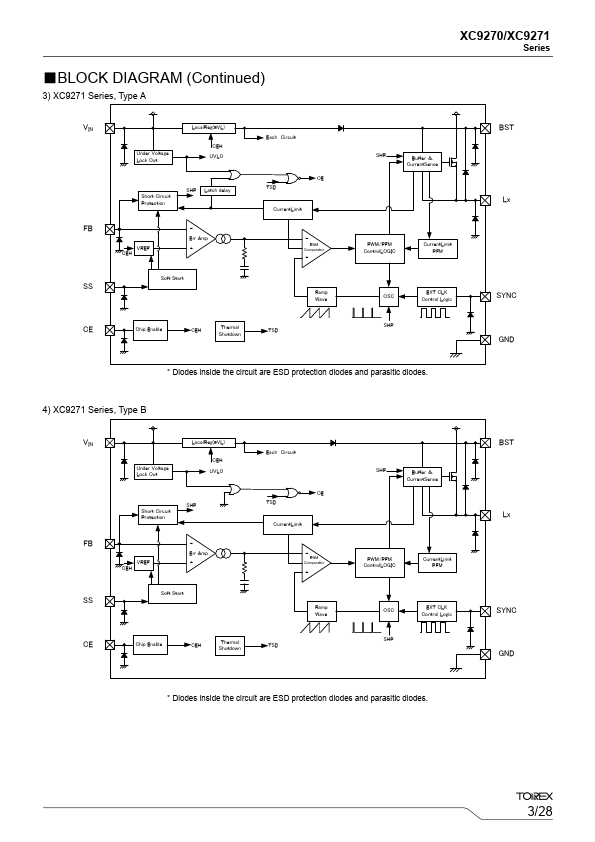
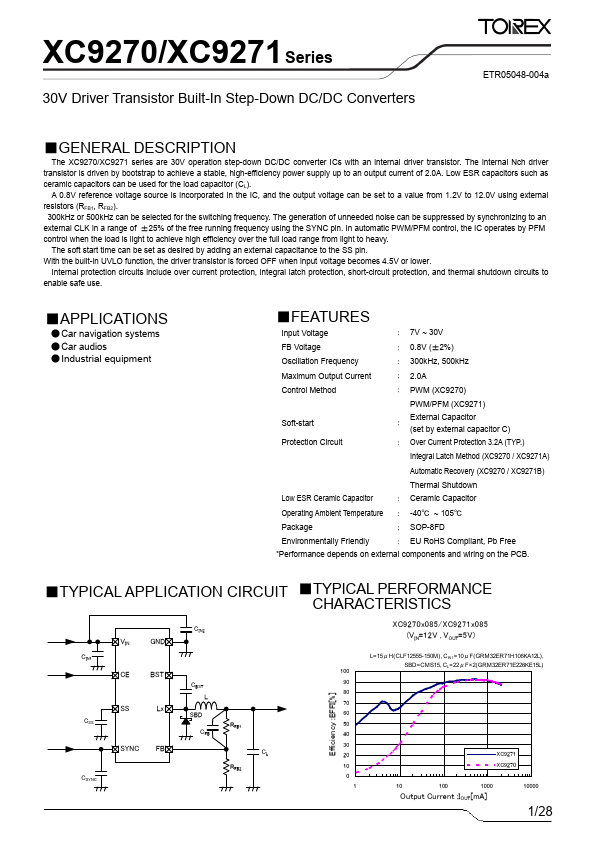
The XC9270/XC9271 series are 30V operation step-down DC/DC converter ICs with an internal driver transistor.

The internal Nch driver transistor is driven by bootstrap to achieve a stable, high-efficiency power supply up to an output current of 2.0A.

Features

  • Input Voltage : 7V ~ 30V FB Voltage : 0.8V (±2%) Oscillation Frequency : 300kHz, 500kHz Maximum Output Current : 2.0A Control Method : PWM (XC9270) PWM/PFM (XC9271) Soft-start : External Capacitor (set by external capacitor C) Protection Circuit : Over Current Protection 3.2A (TYP. ) Integral Latch Method (XC9270 / XC9271A) Automatic Recovery (XC9270 / XC9271B) Thermal Shutdown Low ESR Ceramic Capacitor : Ceramic Capacitor Operating Ambient Temperature : -40℃ ~ 105℃ Package.

📥 Download Datasheet

Datasheet preview – XC9271

Datasheet Details

Part number XC9271
Manufacturer Torex Semiconductor
File Size 0.98 MB
Description 30V Driver Transistor Built-In Step-Down DC/DC Converters
Datasheet download datasheet XC9271 Datasheet
Additional preview pages of the XC9271 datasheet.
Other Datasheets by Torex

Full PDF Text Transcription

Click to expand full text
XC9270/XC9271 Series 30V Driver Transistor Built-In Step-Down DC/DC Converters ETR05048-004a ■GENERAL DESCRIPTION The XC9270/XC9271 series are 30V operation step-down DC/DC converter ICs with an internal driver transistor. The internal Nch driver transistor is driven by bootstrap to achieve a stable, high-efficiency power supply up to an output current of 2.0A. Low ESR capacitors such as ceramic capacitors can be used for the load capacitor (CL). A 0.8V reference voltage source is incorporated in the IC, and the output voltage can be set to a value from 1.2V to 12.0V using external resistors (RFB1, RFB2). 300kHz or 500kHz can be selected for the switching frequency.
Published: |