TA48LS025F
TA48LS025F is 300mA Output Current and Low Dropout Voltage Regulator manufactured by Toshiba.
- Part of the TA48LS015F comparator family.
- Part of the TA48LS015F comparator family.
TA48LS015,018,025,033,05F
TOSHIBA Bipolar Linear Integrated Circuit Silicon Monolithic
TA48LS015F,TA48LS018F,TA48LS025F,TA48LS033F,TA48LS05F
300 m A Output Current and Low Dropout Voltage Regulator with ON/OFF Control Switch
The TA48LS-
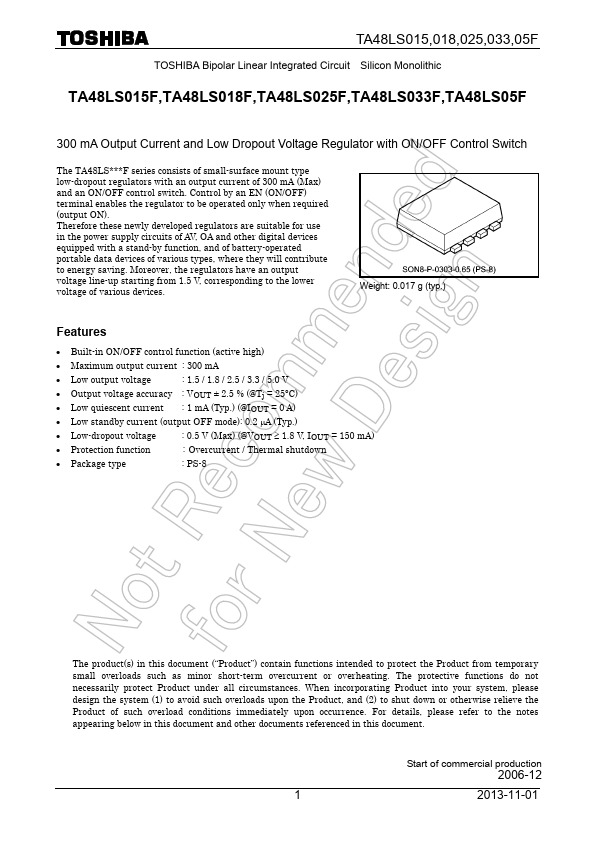
- - F series consists of small-surface mount type low-dropout regulators with an output current of 300 m A (Max) and an ON/OFF control switch. Control by an EN (ON/OFF) terminal enables the regulator to be operated only when required (output ON). Therefore these newly developed regulators are suitable for use in the power supply circuits of AV, OA and other digital devices equipped with a stand-by function, and of battery-operated portable data devices of various types, where they will contribute to energy saving. Moreover, the regulators have an output voltage line-up starting from 1.5 V, corresponding to the lower voltage of various devices.
Weight: 0.017 g (typ.)
Features
- Built-in ON/OFF control function (active high)
- Maximum output current : 300 m A
- Low output voltage
: 1.5 / 1.8 / 2.5 / 3.3 / 5.0 V
- Output voltage accuracy : VOUT ± 2.5 % (@Tj = 25°C)
- Low quiescent current : 1 m A (Typ.) (@IOUT = 0 A)
- Low standby current (output OFF mode): 0.2 μA (Typ.)
- Low-dropout voltage
: 0.5 V (Max) (@VOUT ≥ 1.8 V, IOUT = 150 m A)
- Protection function
: Overcurrent / Thermal shutdown
- Package type
: PS-8
The product(s) in this document (“Product”) contain functions intended to protect the Product from temporary small overloads such as minor short-term overcurrent or overheating. The protective functions do not necessarily protect Product under all circumstances. When incorporating Product into your system, please design the system (1) to avoid such overloads upon the Product, and (2) to shut down or otherwise relieve the Product of such overload conditions immediately upon occurrence. For details, please refer to the notes appearing below in this document and other documents referenced in this document.
Start of...