Datasheet4U Logo Datasheet4U.com

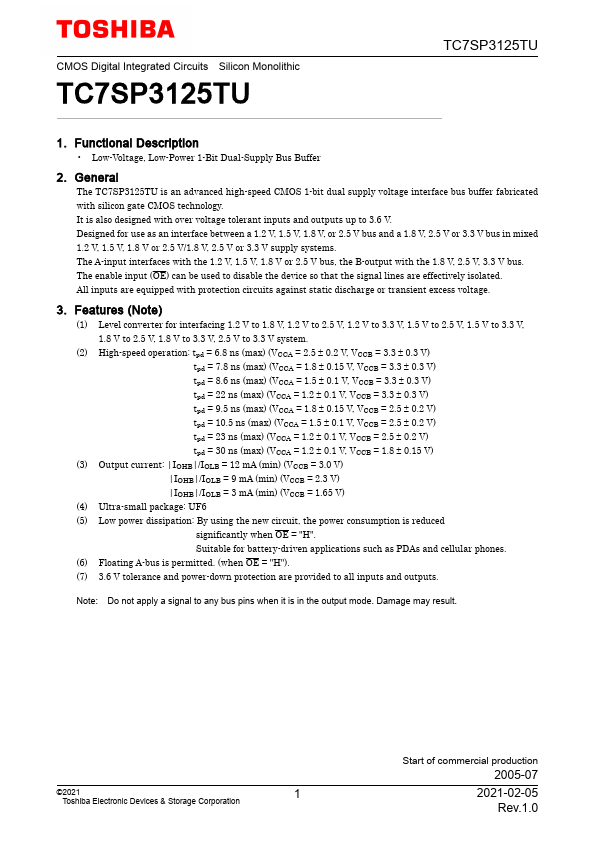
TC7SP3125TU - Low Voltage/Low Power 1-Bit Dual Supply Bus Buffer

General Description

2.

The TC7SP3125TU is an advanced high-speed CMOS 1-bit dual supply voltage interface bus buffer fabricated with silicon gate CMOS technology.

It is also designed with over voltage tolerant inputs and outputs up to 3.6 V.

Key Features

  • (Note) (1) Level converter for interfacing 1.2 V to 1.8 V, 1.2 V to 2.5 V, 1.2 V to 3.3 V, 1.5 V to 2.5 V, 1.5 V to 3.3 V, 1.8 V to 2.5 V, 1.8 V to 3.3 V, 2.5 V to 3.3 V system. (2) High-speed operation: tpd = 6.8 ns (max) (VCCA = 2.5 ± 0.2 V, VCCB = 3.3 ± 0.3 V) tpd = 7.8 ns (max) (VCCA = 1.8 ± 0.15 V, VCCB = 3.3 ± 0.3 V) tpd = 8.6 ns (max) (VCCA = 1.5 ± 0.1 V, VCCB = 3.3 ± 0.3 V) tpd = 22 ns (max) (VCCA = 1.2 ± 0.1 V, VCCB = 3.3 ± 0.3 V) tpd = 9.5 ns (max) (VCCA = 1.8 ± 0.15 V, VCCB = 2.5 ± 0.

📥 Download Datasheet

Datasheet Details

Part number TC7SP3125TU
Manufacturer Toshiba
File Size 207.18 KB
Description Low Voltage/Low Power 1-Bit Dual Supply Bus Buffer
Datasheet download datasheet TC7SP3125TU Datasheet

Full PDF Text Transcription (Reference)

The following content is an automatically extracted verbatim text from the original manufacturer datasheet and is provided for reference purposes only.

View original datasheet text
CMOS Digital Integrated Circuits Silicon Monolithic TC7SP3125TU TC7SP3125TU 1. Functional Description • Low-Voltage, Low-Power 1-Bit Dual-Supply Bus Buffer 2. General The TC7SP3125TU is an advanced high-speed CMOS 1-bit dual supply voltage interface bus buffer fabricated with silicon gate CMOS technology. It is also designed with over voltage tolerant inputs and outputs up to 3.6 V. Designed for use as an interface between a 1.2 V, 1.5 V, 1.8 V, or 2.5 V bus and a 1.8 V, 2.5 V or 3.3 V bus in mixed 1.2 V, 1.5 V, 1.8 V or 2.5 V/1.8 V, 2.5 V or 3.3 V supply systems. The A-input interfaces with the 1.2 V, 1.5 V, 1.8 V or 2.5 V bus, the B-output with the 1.8 V, 2.5 V, 3.3 V bus. The enable input (OE) can be used to disable the device so that the signal lines are effectively isolated.