
Datasheet Details
| Part number | TQP5115 |
|---|---|
| Manufacturer | TriQuint Semiconductor |
| File Size | 192.11 KB |
| Description | 11.3 Gb/s EML Driver |
| Datasheet |
 TQP5115 Datasheet TQP5115 Datasheet
|
|
|
|

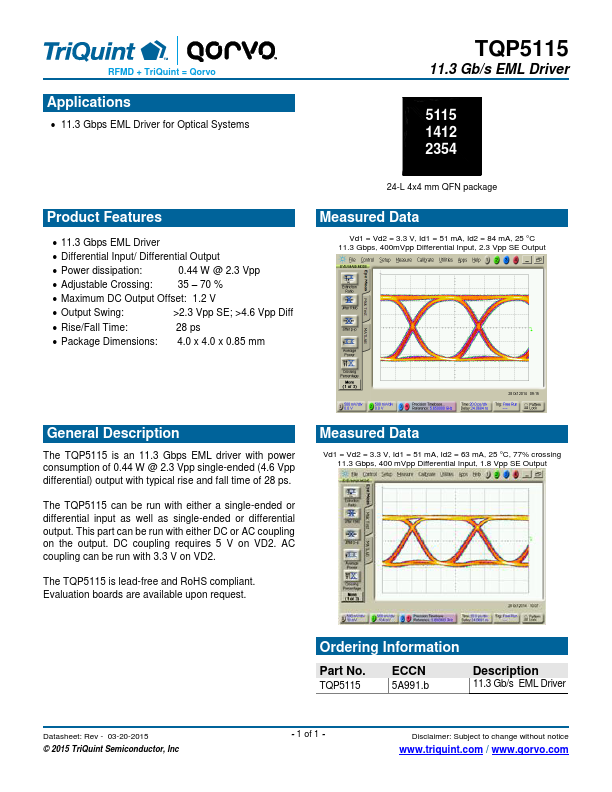
The TQP5115 is an 11.3 Gbps EML driver with power consumption of 0.44 W @ 2.3 Vpp single-ended (4.6 Vpp differential) output with typical rise and fall time of 28 ps.
The TQP5115 can be run with either a single-ended or differential input as well as single-ended or differential output.
| Part number | TQP5115 |
|---|---|
| Manufacturer | TriQuint Semiconductor |
| File Size | 192.11 KB |
| Description | 11.3 Gb/s EML Driver |
| Datasheet |
TQP5115 Datasheet
|
|
|
|
Note: Below is a high-fidelity text extraction (approx. 800 characters) for TQP5115. For precise diagrams, and layout, please refer to the original PDF.
RFMD + TriQuint = Qorvo Applications 11.3 Gbps EML Driver for Optical Systems TQP5115 11.3 Gb/s EML Driver 5115 1412 2354 Product Features 11.3 Gbps EML Driver Diff...
| Part Number | Description |
|---|---|
| TQP519021 | High IP3 Dual Channel Downconverter |
| TQP5523 | High-Power 5GHz WLAN Power Amplifier |
| TQP5525 | High-Power 5GHz WLAN Power Amplifier |
| TQP569022 | High IP3 Dual Channel Downconverter |
| TQP0102 | GaN Power Transistor |
| TQP0103 | GaN Power Transistor |
| TQP0104 | GaN Power Transistor |
| TQP13-N | 0.13 um D pHEMT Foundry Service |
| TQP15 | 0.15 um D-mode pHEMT Foundry Service |
| TQP200002 | ESD Protection Circuit |