VO206AT
VO206AT is Optocoupler manufactured by Vishay.
- Part of the VO205AT comparator family.
- Part of the VO205AT comparator family.
FEATURES
- High BVCEO, 70 V
- Isolation test voltage, 4000 VRMS
- Material categorization: For definitions of pliance please see .vishay./doc?99912 i179074
DESCRIPTION
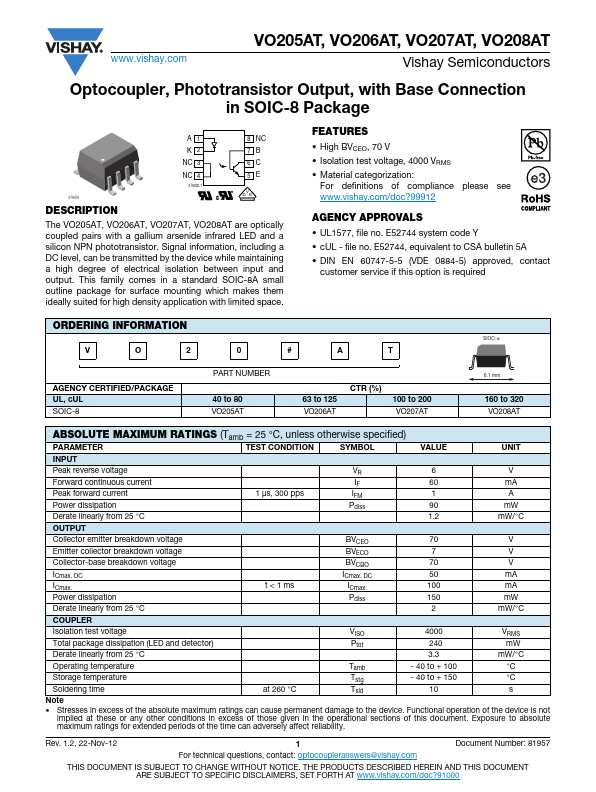
The VO205AT, VO206AT, VO207AT, VO208AT are optically coupled pairs with a gallium arsenide infrared LED and a silicon NPN phototransistor. Signal information, including a DC level, can be transmitted by the device while maintaining a high degree of electrical isolation between input and output. This family es in a standard SOIC-8A small outline package for surface mounting which makes them ideally suited for high density application with limited space.
AGENCY APPROVALS
- UL1577, file no. E52744 system code Y
- c UL
- file no. E52744, equivalent to CSA bulletin 5A
- DIN EN 60747-5-5 (VDE 0884-5) approved, contact customer service if this option is required
ORDERING INFORMATION
SIOC-8
0 PART NUMBER
#
6.1 mm
AGENCY CERTIFIED/PACKAGE UL, c UL SOIC-8
CTR (%) 40 to 80 VO205AT 63 to 125 VO206AT 100 to 200 VO207AT 160 to 320 VO208AT
ABSOLUTE MAXIMUM RATINGS (Tamb = 25 °C, unless otherwise specified)
PARAMETER TEST CONDITION SYMBOL VALUE UNIT INPUT Peak reverse voltage VR 6 V Forward continuous current IF 60 m A 1 A Peak forward current 1 μs, 300 pps IFM Power dissipation Pdiss 90 m W Derate linearly from 25 °C 1.2 m W/°C OUTPUT Collector emitter breakdown voltage BVCEO 70 V Emitter collector breakdown voltage BVECO 7 V 70 V Collector-base breakdown voltage BVCBO ICmax. DC ICmax. DC 50 m A ICmax. t < 1 ms ICmax. 100 m A 150 m W Power dissipation Pdiss Derate linearly from 25 °C 2 m W/°C COUPLER 4000 VRMS Isolation test voltage VISO Total package dissipation (LED and detector) Ptot 240 m W Derate linearly from 25 °C 3.3 m W/°C
- 40 to + 100 °C Operating temperature Tamb Storage temperature Tstg
- 40 to + 150 °C Soldering time at 260 °C Tsld 10 s Note
- Stresses in excess of the absolute maximum ratings can cause permanent damage to the device. Functional operation of the device is not implied at...