

WJA1025
WJA1025 is 5V Active-Bias InGaP HBT Gain Block manufactured by WJ Communication.
Features
- Cascadable gain block
- 50
- 4000 MHz
- 17 d B Gain @ 1.9GHz ..
- +15.5 d Bm P1d B @ 1.9GHz
- +32 d Bm OIP3 @ 1.9GHz
- Operates from +5V @ 60m A
- Robust 1000V ESD, Class 1C
- Ro HS-pliant SOT-89 package
+5V Active-Bias In Ga P HBT Gain Block
Product Description
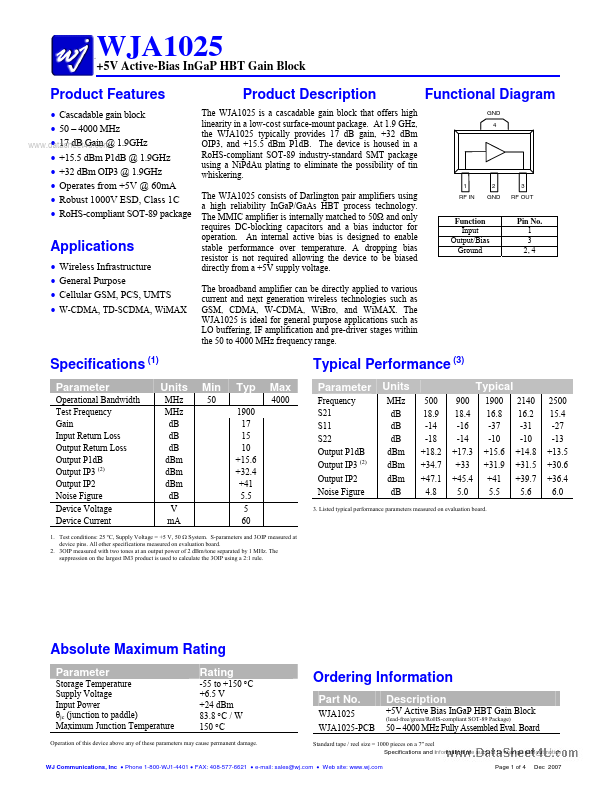
The WJA1025 is a cascadable gain block that offers high linearity in a low-cost surface-mount package. At 1.9 GHz, the WJA1025 typically provides 17 d B gain, +32 d Bm OIP3, and +15.5 d Bm P1d B. The device is housed in a Ro HS-pliant SOT-89 industry-standard SMT package using a Ni Pd Au plating to eliminate the possibility of tin whiskering.
Functional Diagram
GND 4
2 GND
3 RF OUT
Applications
- -
- - Wireless Infrastructure General Purpose Cellular GSM, PCS, UMTS W-CDMA, TD-SCDMA, Wi MAX
The WJA1025 consists of Darlington pair amplifiers using a high reliability In Ga P/Ga As HBT process technology. The MMIC amplifier is internally matched to 50Ω and only requires DC-blocking capacitors and a bias inductor for operation. An internal active bias is designed to enable stable performance over temperature. A dropping bias resistor is not required allowing the device to be biased directly from a +5V supply voltage. The broadband amplifier can be directly applied to various current and next generation wireless technologies such as GSM, CDMA, W-CDMA, Wi Bro, and Wi MAX. The WJA1025 is ideal for general purpose applications such as LO buffering, IF amplification and pre-driver stages within the 50 to 4000 MHz frequency range.
RF IN
Function Input Output/Bias Ground
Pin No. 1 3 2, 4
Specifications (1)
Parameter
Operational Bandwidth Test Frequency Gain Input Return Loss Output Return Loss Output P1d B Output IP3 (2) Output IP2 Noise Figure Device Voltage Device Current
Typical Performance (3)
Units
MHz MHz d B d B d B d Bm d Bm d Bm d B V m A
Min
Typ
1900 17 15 10 +15.6 +32.4 +41 5.5 5 60
Max
Parameter Units
Frequency S21 S11 S22 Output P1d B Output IP3 (2) Output IP2 Noise Figure MHz d B d B d B d Bm d Bm d Bm d...