75ALS171A
75ALS171A is TRIPLE DIFFERENTIAL BUS TRANSCEIVERS manufactured by Texas Instruments.
SN75ALS171, SN75ALS171A TRIPLE DIFFERENTIAL BUS TRANSCEIVERS
D Three Bidirectional Transceivers D Driver Meets or Exceeds the Requirements of ANSI EIA/TIA-422-B and RS-485 and ITU
Remendation V.11
D Two Skew Limits Available D Designed to Operate Up to 20 Million Data
Transfers per Second (FAST-20 SCSI)
D High-Speed Advanced Low-Power Schottky
Circuitry
D Low Pulse Skew . . . 5 ns Max D Designed for Multipoint Transmission on
Long Bus Lines in Noisy Environments
D Features
Independent Driver Enables and bined Receiver Enables
D Wide Positive and Negative Input/Output
Bus Voltages Ranges
D Driver Output Capacity . . . ± 60 m A D Thermal Shutdown Protection D Driver Positive- and Negative-Current
Limiting
D Receiver Input Impedances . . . 12 kΩ Min D Receiver Input Sensitivity . . . ± 300 m V Max D Receiver Input Hysteresis . . . 60 m V Typ D Operates From a Single 5-V Supply D Glitch-Free Power-Up and Power-Down
Protection
SLLS056D
- AUGUST 1987
- REVISED SEPTEMBER 1995
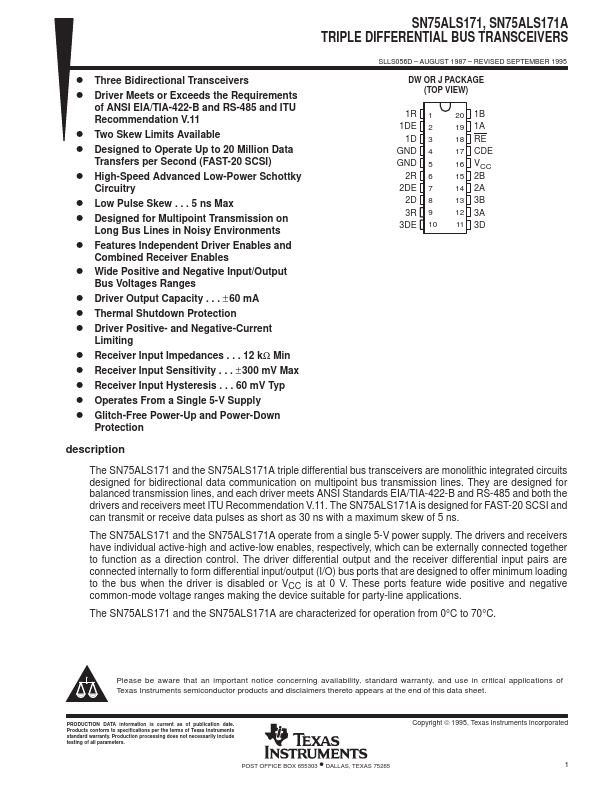
DW OR J PACKAGE (TOP VIEW)
1R 1 1DE 2
1D 3 GND 4 GND 5
2R 6 2DE 7
2D 8 3R 9 3DE 10
20 1B 19 1A 18 RE 17 CDE 16 VCC 15 2B 14 2A 13 3B 12 3A 11 3D description
The SN75ALS171 and the SN75ALS171A triple differential bus transceivers are monolithic integrated circuits designed for bidirectional data munication on multipoint bus transmission lines. They are designed for balanced transmission lines, and each driver meets ANSI Standards EIA/TIA-422-B and RS-485 and both the drivers and receivers meet ITU Remendation V.11. The SN75ALS171A is designed for FAST-20 SCSI and can transmit or receive data pulses as short as 30 ns with a maximum skew of 5 ns.
The SN75ALS171 and the SN75ALS171A operate from a single 5-V power supply. The drivers and receivers have individual active-high and active-low enables, respectively, which can be externally connected together to function as a direction control. The driver differential output and the receiver differential input pairs are connected internally to...