• Part: AFE4300
  • Description: Integrated Analog Front-End
  • Manufacturer: Texas Instruments
  • Size: 679.63 KB
Download AFE4300 Datasheet PDF
Texas Instruments
AFE4300
AFE4300 is Integrated Analog Front-End manufactured by Texas Instruments.
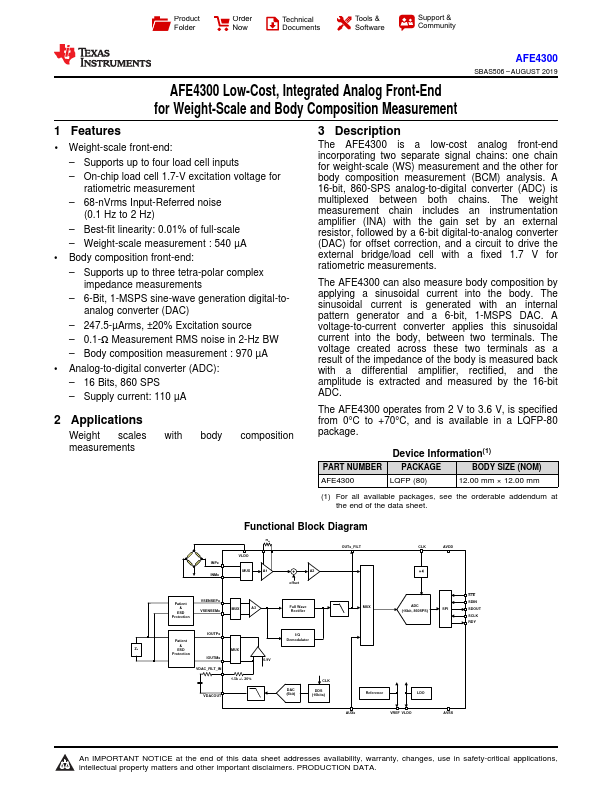
Product Folder Order Now Technical Documents Tools & Software Support & munity AFE4300 Low-Cost, Integrated Analog Front-End for Weight-Scale and Body position Measurement SBAS506 - AUGUST 2019 1 Features - 1 Weight-scale front-end: - Supports up to four load cell inputs - On-chip load cell 1.7-V excitation voltage for ratiometric measurement - 68-n Vrms Input-Referred noise (0.1 Hz to 2 Hz) - Best-fit linearity: 0.01% of full-scale - Weight-scale measurement : 540 µA - Body position front-end: - Supports up to three tetra-polar plex impedance measurements - 6-Bit, 1-MSPS sine-wave generation digital-toanalog converter (DAC) - 247.5-µArms, ±20% Excitation source - 0.1-Ω Measurement RMS noise in 2-Hz BW - Body position measurement : 970 µA - Analog-to-digital converter (ADC): - 16 Bits, 860 SPS - Supply current: 110 µA 2 Applications Weight scales with body position measurements 3 Description The AFE4300 is a low-cost analog front-end incorporating two separate signal chains: one chain for weight-scale (WS) measurement and the other for body position measurement (BCM) analysis. A 16-bit, 860-SPS analog-to-digital converter (ADC) is multiplexed between both chains. The weight measurement chain includes an instrumentation amplifier (INA) with the gain set by an external resistor, followed by a 6-bit digital-to-analog converter (DAC) for offset correction, and a circuit to drive the external bridge/load cell with a fixed 1.7 V for ratiometric measurements. The AFE4300 can also measure body position by applying a sinusoidal current into the body. The sinusoidal current is generated with an internal pattern generator and a 6-bit, 1-MSPS DAC. A voltage-to-current converter applies this sinusoidal current into the body, between two terminals. The voltage created across these two terminals as a result of the impedance of the body is measured back with a differential amplifier, rectified, and the amplitude is extracted and measured by...