

Datasheet4U Logo Datasheet4U.com

AM26C31Q - Quadruple Differential Line Driver

Download the AM26C31Q datasheet PDF. This datasheet also covers the AM26C31 variant, as both devices belong to the same quadruple differential line driver family and are provided as variant models within a single manufacturer datasheet.

Description

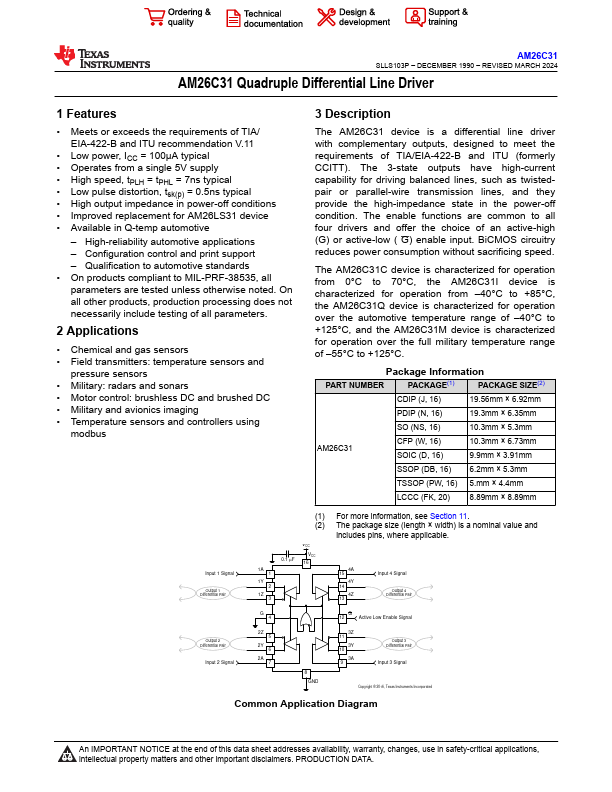
The AM26C31 device is a differential line driver with complementary outputs, designed to meet the requirements of TIA/EIA-422-B and ITU (formerly CCITT).

Features

  • Meets or exceeds the requirements of TIA/ EIA-422-B and ITU recommendation V.11.
  • Low power, ICC = 100μA typical.
  • Operates from a single 5V supply.
  • High speed, tPLH = tPHL = 7ns typical.
  • Low pulse distortion, tsk(p) = 0.5ns typical.
  • High output impedance in power-off conditions.
  • Improved replacement for AM26LS31 device.
  • Available in Q-temp automotive.
  • High-reliability automotive.

📥 Download Datasheet

Note: The manufacturer provides a single datasheet file (AM26C31-etcTI.pdf) that lists specifications for multiple related part numbers.

Full PDF Text Transcription (Reference)

The following content is an automatically extracted verbatim text from the original manufacturer datasheet and is provided for reference purposes only.

View original datasheet text
AM26C31 SLLS103P – DECEMBER 1990 – REVISED MARCH 2024 AM26C31 Quadruple Differential Line Driver 1 Features • Meets or exceeds the requirements of TIA/ EIA-422-B and ITU recommendation V.11 • Low power, ICC = 100μA typical • Operates from a single 5V supply • High speed, tPLH = tPHL = 7ns typical • Low pulse distortion, tsk(p) = 0.5ns typical • High output impedance in power-off conditions • Improved replacement for AM26LS31 device • Available in Q-temp automotive – High-reliability automotive applications – Configuration control and print support – Qualification to automotive standards • On products compliant to MIL-PRF-38535, all parameters are tested unless otherwise noted. On all other products, production processing does not necessarily include testing of all parameters.
Published: |