BQ51010B
BQ51010B is Highly Integrated Wireless Receiver manufactured by Texas Instruments.
Features
- 1 Integrated Wireless Power Supply Receiver Solution With a 7-V Regulated Supply
- 93% Overall Peak AC-DC Efficiency
- Full Synchronous Rectifier
- WPC v1.1 pliant munication Control
- Output Voltage Conditioning
- Only IC Required Between RX Coil and 7-V Output
- WPC v1.1 pliant (FOD Enabled) Highly Accurate Current Sense
- Dynamic Rectifier Control for Improved Load Transient Response
- Dynamic Efficiency Scaling for Optimized Performance Over Wide Range of Output Power
- Adaptive munication Limit for Robust munication
- Supports 20-V Maximum Input
- Low-power Dissipative Rectifier Overvoltage
Clamp (VOVP = 15 V)
- Thermal Shutdown
- Multifunction NTC and Control Pin for
Temperature Monitoring, Charge plete and Fault Host Control
2 Applications
- WPC v1.1 pliant Receivers
- Cell Phones and Smart Phones
- Headsets
- Digital Cameras
- Portable Media Players
- Hand-Held Devices
3 Description
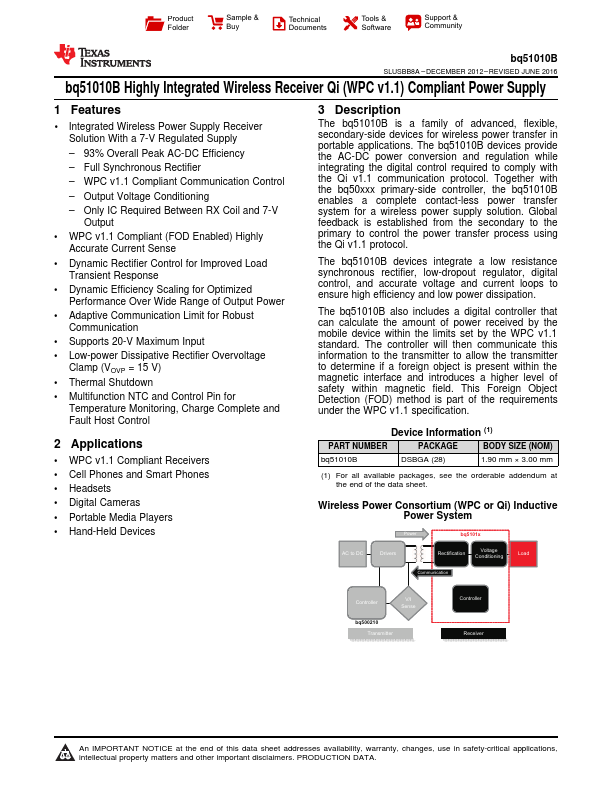
The bq51010B is a family of advanced, flexible, secondary-side devices for wireless power transfer in portable applications. The bq51010B devices provide the AC-DC power conversion and regulation while integrating the digital control required to ply with the Qi v1.1 munication protocol. Together with the bq50xxx primary-side controller, the bq51010B enables a plete contact-less power transfer system for a wireless power supply solution. Global feedback is established from the secondary to the primary to control the power transfer process using the Qi v1.1 protocol.
The bq51010B devices integrate a low resistance synchronous rectifier, low-dropout regulator, digital control, and accurate voltage and current loops to ensure high efficiency and low power dissipation.
The bq51010B also includes a digital controller that can calculate the amount of power received by the mobile device within the limits set by the WPC v1.1 standard. The controller will then municate this information to the transmitter to allow the transmitter to determine if a foreign object is present...