Datasheet4U Logo Datasheet4U.com

CD54ACT374 - Octal D-Type Flip-Flops

Download the CD54ACT374 datasheet PDF. This datasheet also covers the CD54AC374 variant, as both devices belong to the same octal d-type flip-flops family and are provided as variant models within a single manufacturer datasheet.

General Description

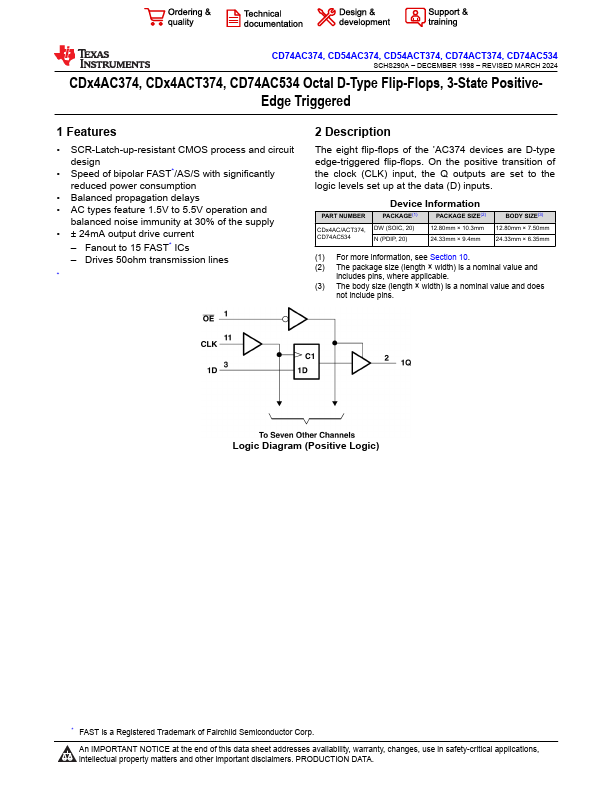
The eight flip-flops of the ’AC374 devices are D-type edge-triggered flip-flops.

On the positive transition of the clock (CLK) input, the Q outputs are set to the logic levels set up at the data (D) inputs.

Key Features

  • SCR-Latch-up-resistant CMOS process and circuit design.
  • Speed of bipolar FAST.
  • /AS/S with significantly reduced power consumption.
  • Balanced propagation delays.
  • AC types feature 1.5V to 5.5V operation and balanced noise immunity at 30% of the supply.
  • ± 24mA output drive current.
  • Fanout to 15 FAST.
  • ICs.
  • Drives 50ohm transmission lines.
  • 2.

📥 Download Datasheet

Note: The manufacturer provides a single datasheet file (CD54AC374-etcTI.pdf) that lists specifications for multiple related part numbers.

Full PDF Text Transcription (Reference)

The following content is an automatically extracted verbatim text from the original manufacturer datasheet and is provided for reference purposes only.

View original datasheet text
CD74AC374, CD54AC374, CD54ACT374, CD74ACT374, CD74AC534 SCHS290A – DECEMBER 1998 – REVISED MARCH 2024 CDx4AC374, CDx4ACT374, CD74AC534 Octal D-Type Flip-Flops, 3-State PositiveEdge Triggered 1 Features • SCR-Latch-up-resistant CMOS process and circuit design • Speed of bipolar FAST*/AS/S with significantly reduced power consumption • Balanced propagation delays • AC types feature 1.5V to 5.5V operation and balanced noise immunity at 30% of the supply • ± 24mA output drive current – Fanout to 15 FAST* ICs – Drives 50ohm transmission lines * 2 Description The eight flip-flops of the ’AC374 devices are D-type edge-triggered flip-flops. On the positive transition of the clock (CLK) input, the Q outputs are set to the logic levels set up at the data (D) inputs.