INA1650
INA1650 is High Common-Mode Rejection Line Receivers manufactured by Texas Instruments.
Features
- 1 High mon-Mode Rejection: 91 d B (Typical)
- High Input Impedance: 1-MΩ Differential
- Ultra-Low Noise:
- 104.7 d Bu, Unweighted
- Ultra-Low Total Harmonic Distortion + Noise:
- 120 d B THD+N (22 d Bu, 22-k Hz Bandwidth)
- Wide Bandwidth: 2.7 MHz
- Low Quiescent Current: 6 m A (INA1651, Typical)
- Short-Circuit Protection
- Integrated EMI Filters
- Wide Supply Range: ±2.25 V to ±18 V
- Available in Small 14-Pin TSSOP Package
2 Applications
- Differential Audio Interfaces
- Audio Input Circuitry
- Line Drivers
- Audio Power Amplifiers
- Audio Analyzers
- High-End Audio and Video (A/V) Receivers
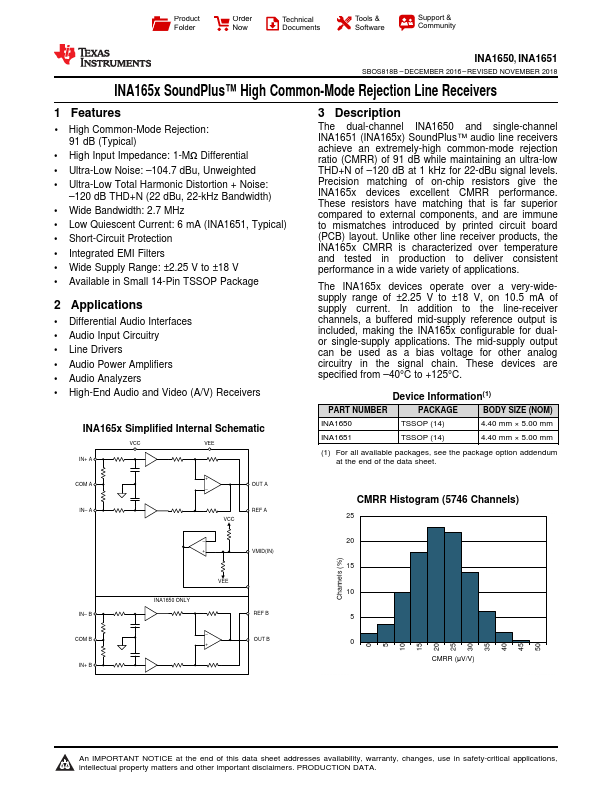
INA165x Simplified Internal Schematic
IN+ A
3 Description
The dual-channel INA1650 and single-channel INA1651 (INA165x) Sound Plus™ audio line receivers achieve an extremely-high mon-mode rejection ratio (CMRR) of 91 d B while maintaining an ultra-low THD+N of
- 120 d B at 1 k Hz for 22-d Bu signal levels. Precision matching of on-chip resistors give the INA165x devices excellent CMRR performance. These resistors have matching that is far superior pared to external ponents, and are immune to mismatches introduced by printed circuit board (PCB) layout. Unlike other line receiver products, the INA165x CMRR is characterized over temperature and tested in production to deliver consistent performance in a wide variety of applications.
The INA165x devices operate over a very-widesupply range of ±2.25 V to ±18 V, on 10.5 m A of supply current. In addition to the line-receiver channels, a buffered mid-supply reference output is included, making the INA165x configurable for dualor single-supply applications. The mid-supply output can be used as a bias voltage for other analog circuitry in the signal chain. These devices are specified from
- 40°C to +125°C.
Device Information(1)
PART NUMBER
PACKAGE
BODY SIZE (NOM)
TSSOP (14)
4.40 mm × 5.00 mm
INA1651
TSSOP (14)
4.40 mm × 5.00 mm
(1) For all available packages, see the package option addendum at the end of the...