LM137HVQML
LM137HVQML is 3-Terminal Adjustable Negative Regulators manufactured by Texas Instruments.
FEATURES
- 2 Output Voltage Adjustable from
- 47V to
- 1.2V
- 1.5A Output Current Specified,
- 55°C ≤ TJ ≤
+150°C
- Line Regulation Typically 0.01%/V
- Load Regulation Typically 0.3%
- Excellent Thermal Regulation, 0.002%/W
- 77 d B Ripple Rejection
- Excellent Rejection of Thermal Transients
- 50 ppm/°C Temperature Coefficient
- Temperature-Independent Current Limit
- Internal Thermal Overload Protection
- Standard 3-Lead Transistor Package
- Output Short Circuit Protected
DESCRIPTION
The LM137HV is an adjustable 3-terminal negative voltage regulator capable of supplying in excess of
- 1.5A over an output voltage range of
- 47V to
- 1.2V. This regulators is exceptionally easy to apply, requiring only 2 external resistors to set the output voltage and 1 output capacitor for frequency pensation. The circuit design has been optimized for excellent regulation and low thermal transients. Further, the LM137HV features internal current limiting, thermal shutdown and safe-area pensation, making them virtually blowout-proof against overloads.
The LM137HV serves a wide variety of applications including local on-card regulation, programmableoutput voltage regulation or precision current regulation. The LM137HV is an ideal plement to the LM117HV adjustable positive regulator.
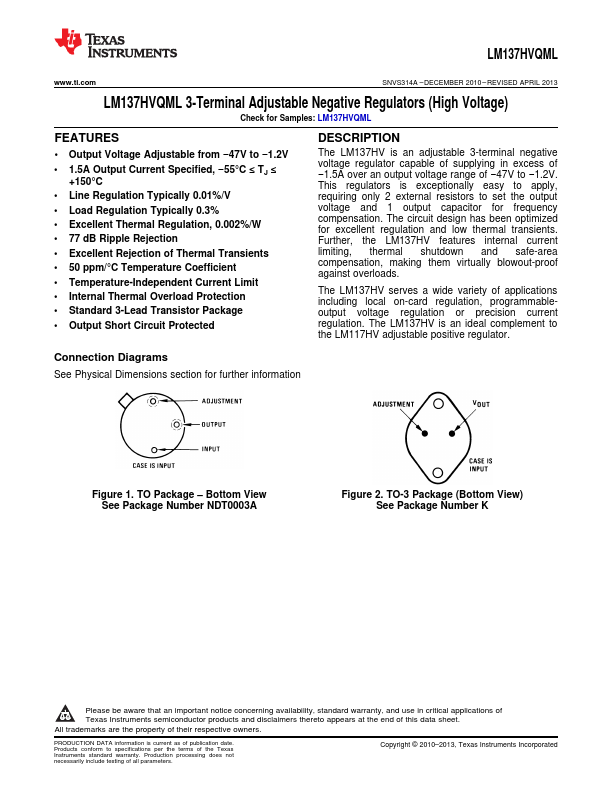
Connection Diagrams See Physical Dimensions section for further information
Figure 1. TO Package
- Bottom View See Package Number NDT0003A
Figure 2. TO-3 Package (Bottom View) See Package Number K
Please be aware that an important notice concerning availability, standard warranty, and use in critical applications of Texas Instruments semiconductor products and disclaimers thereto appears at the end of this data sheet. All trademarks are the property of their respective owners.
PRODUCTION DATA information is current as of publication date. Products conform to specifications per the terms of the Texas Instruments standard warranty. Production processing does not necessarily include testing of all...