LM140K
LM140K is 3-Terminal Positive Regulator manufactured by Texas Instruments.
FEATURES
- 2 plete Specifications at 1A Load
- Output Voltage Tolerances of ±4% at Tj = 25°C
- Internal Thermal Overload Protection
- Internal Short-circuit Current Limit
- Output Transistor Safe Area Protection
- P+ Product Enhancement Tested
DESCRIPTION
The LM140K monolithic 3-terminal positive voltage regulator employs internal current-limiting, thermal shutdown and safe-area pensation, making them essentially indestructible. If adequate heat sinking is provided, they can deliver over 1.0A output current. They are intended as fixed voltage regulators in a wide range of applications including local (on-card) regulation for elimination of noise and distribution problems associated with single-point regulation. In addition to use as fixed voltage regulators, these devices can be used with external ponents to obtain adjustable output voltages and currents.
Considerable effort was expended to make the entire series of regulators easy to use and minimize the number of external ponents. It is not necessary to bypass the output, although this does improve transient response. Input bypassing is needed only if the regulator is located far from the filter capacitor of the power supply.
The LM140K is available in 5V, 12V and 15V options in the steel TO-3 power package.
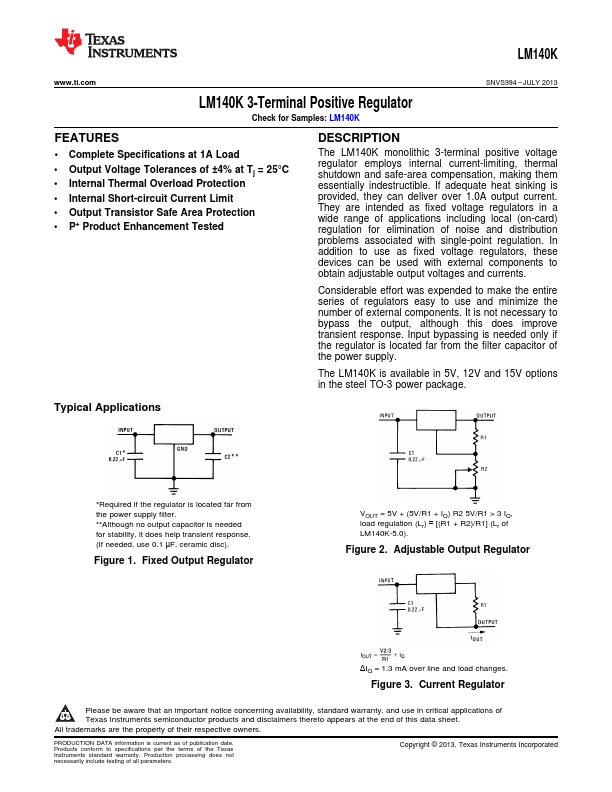
Typical Applications
- Required if the regulator is located far from the power supply filter.
- - Although no output capacitor is needed for stability, it does help transient response. (If needed, use 0.1 μF, ceramic disc).
Figure 1. Fixed Output Regulator
VOUT = 5V + (5V/R1 + IQ) R2 5V/R1 > 3 IQ, load regulation (Lr) ≈ [(R1 + R2)/R1] (Lr of LM140K-5.0).
Figure 2. Adjustable Output Regulator
ΔIQ = 1.3 m A over line and load changes.
Figure 3. Current Regulator
Please be aware that an important notice concerning availability, standard warranty, and use in critical applications of Texas Instruments semiconductor products and disclaimers thereto appears at the end of this data sheet. All trademarks are the...