

LM2937
LM2937 is 500-mA Low Dropout Regulator manufactured by Texas Instruments.
Features
- 1 Fully Specified for Operation Over
- 40°C to 125°C
- Output Current in Excess of 500 m A
- Output Trimmed for 5% Tolerance Under all
Operating Conditions
- Typical Dropout Voltage of 0.5 V at Full Rated
Load Current
- Wide Output Capacitor ESR Range, up to 3 Ω
- Internal Short Circuit and Thermal Overload
Protection
- Reverse Battery Protection
- 60-V Input Transient Protection
- Mirror Image Insertion Protection
2 Applications
- Automotive
- Industrial Control
- Point-of-Load regulation space space space
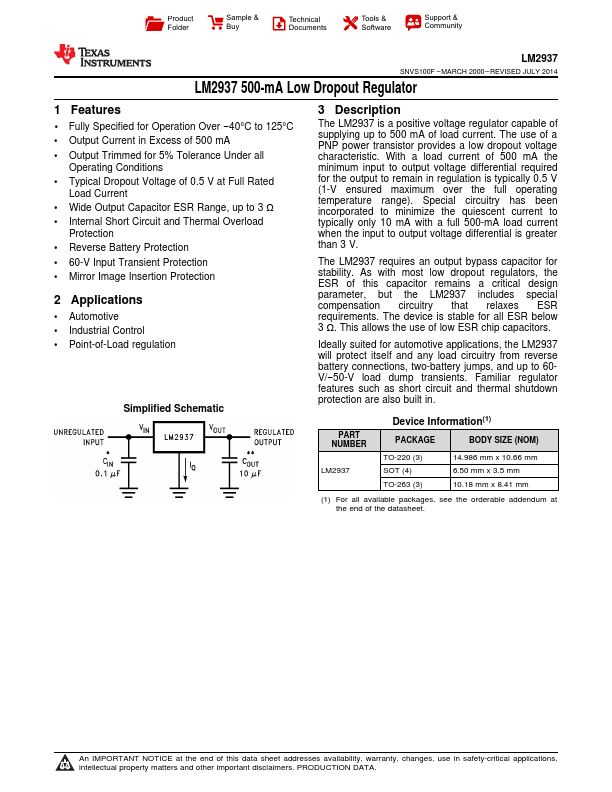
Simplified Schematic
3 Description
The LM2937 is a positive voltage regulator capable of supplying up to 500 m A of load current. The use of a PNP power transistor provides a low dropout voltage characteristic. With a load current of 500 m A the minimum input to output voltage differential required for the output to remain in regulation is typically 0.5 V (1-V ensured maximum over the full operating temperature range). Special circuitry has been incorporated to minimize the quiescent current to typically only 10 m A with a full 500-m A load current when the input to output voltage differential is greater than 3 V.
The LM2937 requires an output bypass capacitor for stability. As with most low dropout regulators, the ESR of this capacitor remains a critical design parameter, but the LM2937 includes special pensation circuitry that relaxes ESR requirements. The device is stable for all ESR below 3 Ω. This allows the use of low ESR chip capacitors.
Ideally suited for automotive applications, the LM2937 will protect itself and any load circuitry from reverse battery connections, two-battery jumps, and up to 60V/- 50-V load dump transients. Familiar regulator features such as short circuit and thermal shutdown protection are also built in.
PART NUMBER
Device Information(1)
PACKAGE
BODY SIZE (NOM)
TO-220 (3) SOT (4) TO-263 (3)
14.986 mm x 10.66 mm 6.50 mm x 3.5 mm 10.18 mm x 8.41 mm
(1) For all available packages, see the orderable addendum at the end...