PTH08T240F
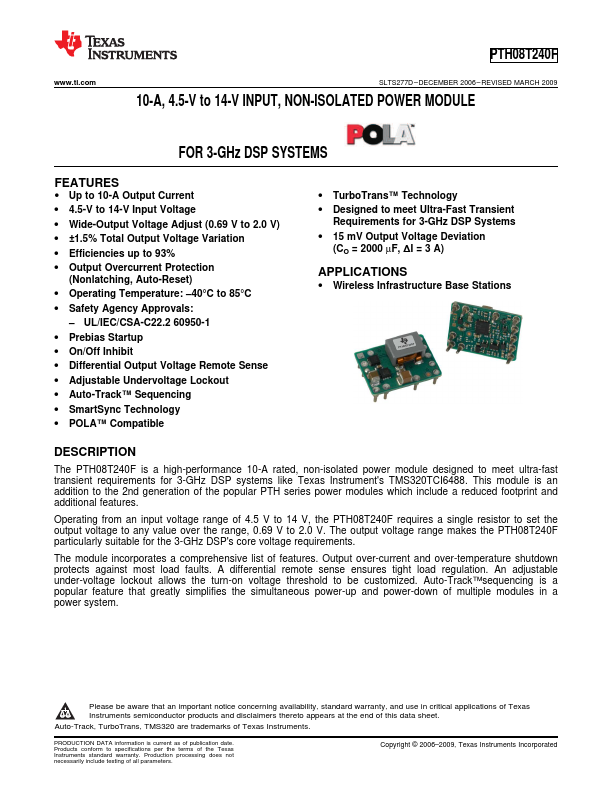
PTH08T240F is NON-ISOLATED POWER MODULE manufactured by Texas Instruments.
FEATURES
- 2 Up to 10-A Output Current
- 4.5-V to 14-V Input Voltage
- Wide-Output Voltage Adjust (0.69 V to 2.0 V)
- ±1.5% Total Output Voltage Variation
- Efficiencies up to 93%
- Output Overcurrent Protection
(Nonlatching, Auto-Reset)
- Operating Temperature:
- 40°C to 85°C
- Safety Agency Approvals:
- UL/IEC/CSA-C22.2 60950-1
- Prebias Startup
- On/Off Inhibit
- Differential Output Voltage Remote Sense
- Adjustable Undervoltage Lockout
- Auto-Track™ Sequencing
- Smart Sync Technology
- POLA™ patible
- Turbo Trans™ Technology
- Designed to meet Ultra-Fast Transient
Requirements for 3-GHz DSP Systems
- 15 m V Output Voltage Deviation
(CO = 2000 µF, ΔI = 3 A)
APPLICATIONS
- Wireless Infrastructure Base Stations
DESCRIPTION
The PTH08T240F is a high-performance 10-A rated, non-isolated power module designed to meet ultra-fast transient requirements for 3-GHz DSP systems like Texas Instrument's TMS320TCI6488. This module is an addition to the 2nd generation of the popular PTH series power modules which include a reduced footprint and additional features
.
Operating from an input voltage range of 4.5 V to 14 V, the PTH08T240F requires a single resistor to set the output voltage to any value over the range, 0.69 V to 2.0 V. The output voltage range makes the PTH08T240F particularly suitable for the 3-GHz DSP's core voltage requirements.
The module incorporates a prehensive list of features
. Output over-current and over-temperature shutdown protects against most load faults. A differential remote sense ensures tight load regulation. An adjustable under-voltage lockout allows the turn-on voltage threshold to be customized. Auto-Track™sequencing is a popular feature that greatly simplifies the simultaneous power-up and power-down of multiple modules in a power system.
Please be aware that an important notice concerning availability, standard warranty, and use in critical applications of Texas Instruments semiconductor products and disclaimers thereto appears at the end...