PTH12050L
PTH12050L is 12-V Input Non-Isolated Wide-Output Adjust Power Module manufactured by Texas Instruments.
- Part of the PTH12050W comparator family.
- Part of the PTH12050W comparator family.
FEATURES
- 2 Up to 6-A Output Current
- 12-V Input Voltage
- Wide-Output Voltage Adjust
(1.2 V to 5.5 V)/(0.8 V to 1.8 V)
- Efficiencies up to 93%
- 200 W/in3 Power Density
- On/Off Inhibit
- Undervoltage Lockout
- Operating Temperature:
- 40°C to 85°C
- Auto-Track™ Sequencing
- Output Overcurrent Protection
(Nonlatching, Auto-Reset)
- Safety Agency Approvals: UL/IEC/CSA-22.2 60950-1
- Point-of-Load Alliance (POLA™) patible
APPLICATIONS
- Tele, Industrial, and General-Purpose Circuits
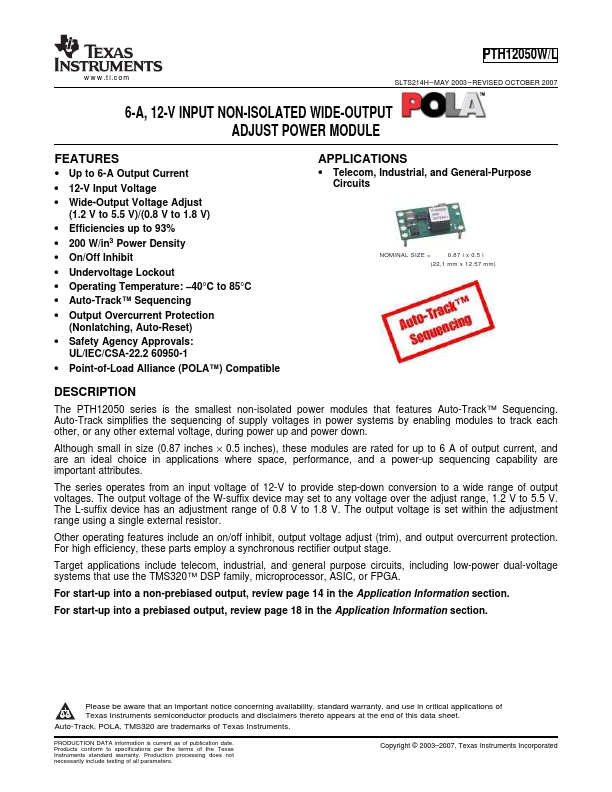
NOMINAL SIZE =
0.87 i x 0.5 i
(22,1 mm x 12,57 mm)
DESCRIPTION
The PTH12050 series is the smallest non-isolated power modules that features
Auto-Track™ Sequencing. Auto-Track simplifies the sequencing of supply voltages in power systems by enabling modules to track each other, or any other external voltage, during power up and power down.
Although small in size (0.87 inches × 0.5 inches), these modules are rated for up to 6 A of output current, and are an ideal choice in applications where space, performance, and a power-up sequencing capability are important attributes.
The series operates from an input voltage of 12-V to provide step-down conversion to a wide range of output voltages. The output voltage of the W-suffix device may set to any voltage over the adjust range, 1.2 V to 5.5 V. The L-suffix device has an adjustment range of 0.8 V to 1.8 V. The output voltage is set within the adjustment range using a single external resistor.
Other operating features include an on/off inhibit, output voltage adjust (trim), and output overcurrent protection. For high efficiency, these parts employ a synchronous rectifier output stage.
Target applications include tele, industrial, and general purpose circuits, including low-power dual-voltage systems that use the TMS320™ DSP family, microprocessor, ASIC, or FPGA.
For start-up into a non-prebiased output, review page 14 in the Application Information section.
For start-up into a prebiased output, review page 18 in the Application...