SN74FB2031
SN74FB2031 is 9-Bit TTL/BTL Address/Data Transceiver manufactured by Texas Instruments.
description
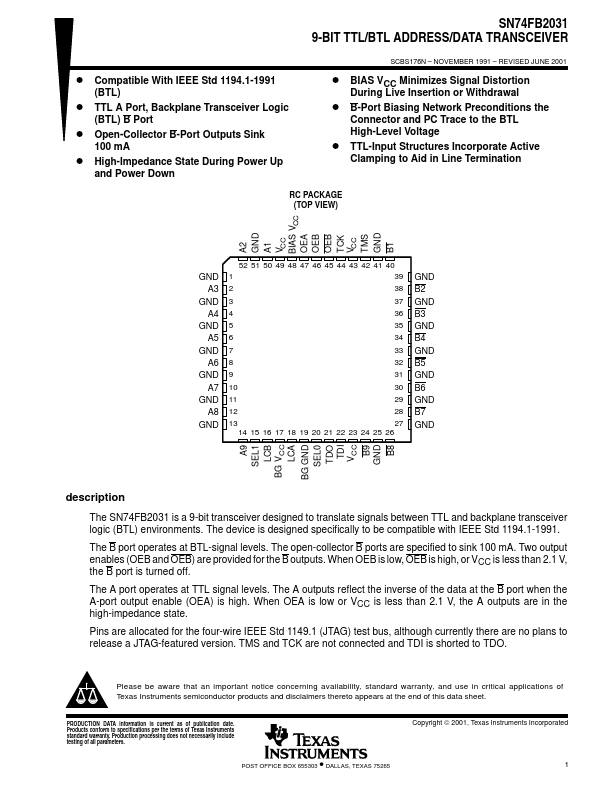
The SN74FB2031 is a 9-bit transceiver designed to translate signals between TTL and backplane transceiver logic (BTL) environments. The device is designed specifically to be patible with IEEE Std 1194.1-1991.
The B port operates at BTL-signal levels. The open-collector B ports are specified to sink 100 m A. Two output enables (OEB and OEB) are provided for the B outputs. When OEB is low, OEB is high, or VCC is less than 2.1 V, the B port is turned off.
The A port operates at TTL signal levels. The A outputs reflect the inverse of the data at the B port when the A-port output enable (OEA) is high. When OEA is low or VCC is less than 2.1 V, the A outputs are in the high-impedance state.
Pins are allocated for the four-wire IEEE Std 1149.1 (JTAG) test bus, although currently there are no plans to release a JTAG-featured version. TMS and TCK are not connected and TDI is shorted to TDO.
Please be aware that an important notice concerning availability, standard warranty, and use in critical applications of Texas Instruments semiconductor products and disclaimers thereto appears at the end of this data sheet.
PRODUCTION DATA information is current as of publication date. Products conform to specifications per the terms of Texas Instruments standard warranty. Production processing does not necessarily include testing of all parameters.
- POST OFFICE BOX 655303 DALLAS, TEXAS 75265
Copyright 2001, Texas Instruments Incorporated 1
SN74FB2031 9-BIT TTL/BTL ADDRESS/DATA TRANSCEIVER
SCBS176N
- NOVEMBER 1991
- REVISED JUNE 2001 description
(continued)
BIAS VCC establishes a voltage between 1.62 V and 2.1 V on the BTL outputs when VCC is not connected. BG VCC and BG GND are the supply inputs for the bias generator.
ORDERING INFORMATION
PACKAGE†
ORDERABLE TOP-SIDE PART NUMBER MARKING
0°C to 70°C QFP
- RC Tube
SN74FB2031RC FB2031
† Package drawings, standard packing quantities, thermal data, symbolization, and PCB design guidelines are available...