• Part: TL494I
  • Description: Pulse-Width-Modulation Controller
  • Manufacturer: Texas Instruments
  • Size: 1.37 MB
Download TL494I Datasheet PDF
Texas Instruments
TL494I
TL494I is Pulse-Width-Modulation Controller manufactured by Texas Instruments.
- Part of the TL494 comparator family.
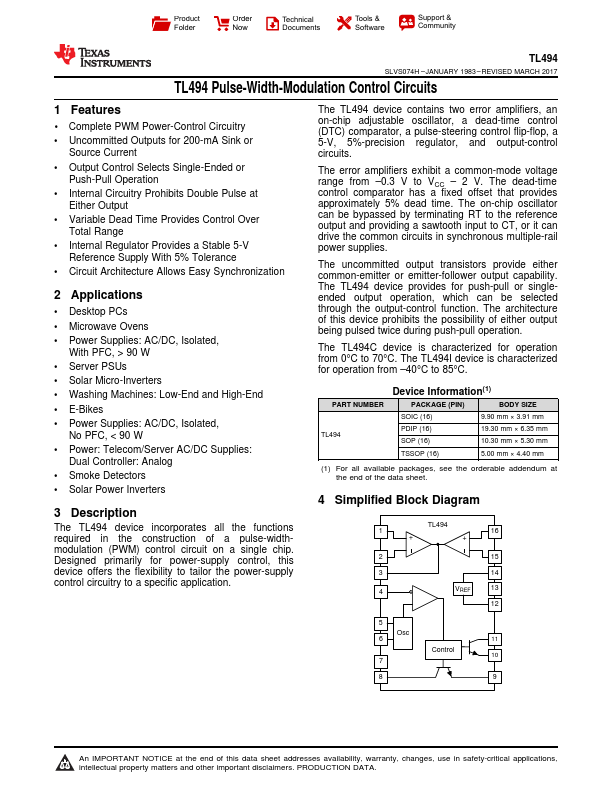
Features - 1 plete PWM Power-Control Circuitry - Unmitted Outputs for 200-m A Sink or Source Current - Output Control Selects Single-Ended or Push-Pull Operation - Internal Circuitry Prohibits Double Pulse at Either Output - Variable Dead Time Provides Control Over Total Range - Internal Regulator Provides a Stable 5-V Reference Supply With 5% Tolerance - Circuit Architecture Allows Easy Synchronization 2 Applications - Desktop PCs - Microwave Ovens - Power Supplies: AC/DC, Isolated, With PFC, > 90 W - Server PSUs - Solar Micro-Inverters - Washing Machines: Low-End and High-End - E-Bikes - Power Supplies: AC/DC, Isolated, No PFC, < 90 W - Power: Tele/Server AC/DC Supplies: Dual Controller: Analog - Smoke Detectors - Solar Power Inverters 3 Description The TL494 device incorporates all the functions required in the construction of a pulse-widthmodulation (PWM) control circuit on a single chip. Designed primarily for power-supply control, this device offers the flexibility to tailor the power-supply control circuitry to a specific application. The TL494 device contains two error amplifiers, an on-chip adjustable oscillator, a dead-time control (DTC) parator, a pulse-steering control flip-flop, a 5-V, 5%-precision regulator, and output-control circuits. The error amplifiers exhibit a mon-mode voltage range from - 0.3 V to VCC - 2 V. The dead-time control parator has a fixed offset that provides approximately 5% dead time. The on-chip oscillator can be bypassed by terminating RT to the reference output and providing a sawtooth input to CT, or it can drive the mon circuits in synchronous multiple-rail power supplies. The unmitted output transistors provide either mon-emitter or emitter-follower output capability. The TL494 device provides for push-pull or singleended output operation, which can be selected through the output-control function. The architecture of this device prohibits the possibility of either output being pulsed twice during push-pull operation. The...