

Datasheet4U Logo Datasheet4U.com

TPA3118D2-Q1 - 100-W and 50-W Class-D Stereo Automotive Amplifiers

Download the TPA3118D2-Q1 datasheet PDF. This datasheet also covers the TPA3116D2-Q1 variant, as both devices belong to the same 100-w and 50-w class-d stereo automotive amplifiers family and are provided as variant models within a single manufacturer datasheet.

General Description

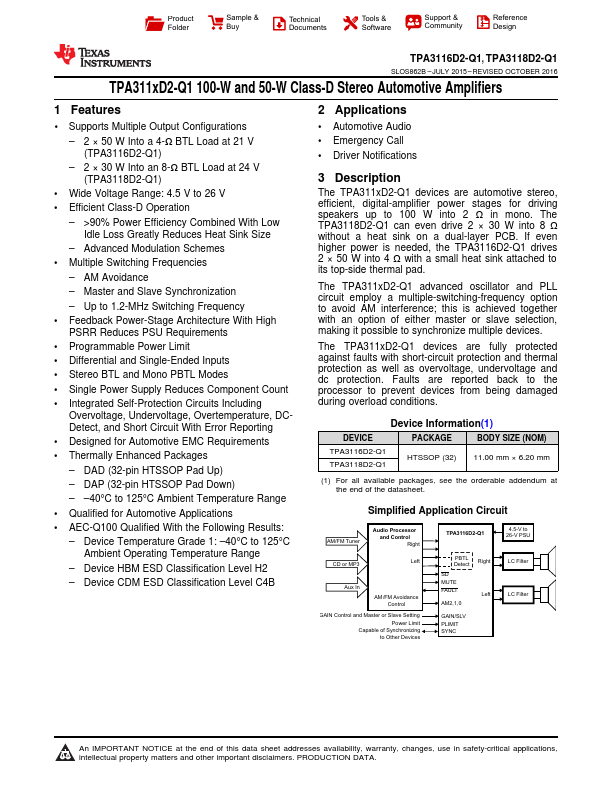
The TPA311xD2-Q1 devices are automotive stereo, efficient, digital-amplifier power stages for driving speakers up to 100 W into 2 Ω in mono.

The TPA3118D2-Q1 can even drive 2 × 30 W into 8 Ω without a heat sink on a dual-layer PCB.

Key Features

  • 1 Supports Multiple Output Configurations.
  • 2 × 50 W Into a 4-Ω BTL Load at 21 V (TPA3116D2-Q1).
  • 2 × 30 W Into an 8-Ω BTL Load at 24 V (TPA3118D2-Q1).
  • Wide Voltage Range: 4.5 V to 26 V.
  • Efficient Class-D Operation.
  • >90% Power Efficiency Combined With Low Idle Loss Greatly Reduces Heat Sink Size.
  • Advanced Modulation Schemes.
  • Multiple Switching Frequencies.
  • AM Avoidance.
  • Master and Slave Synchronization.

📥 Download Datasheet

Note: The manufacturer provides a single datasheet file (TPA3116D2-Q1-etcTI.pdf) that lists specifications for multiple related part numbers.

Full PDF Text Transcription (Reference)

The following content is an automatically extracted verbatim text from the original manufacturer datasheet and is provided for reference purposes only.

View original datasheet text
Product Folder Sample & Buy Technical Documents Tools & Software Support & Community Reference Design TPA3116D2-Q1, TPA3118D2-Q1 SLOS862B – JULY 2015 – REVISED OCTOBER 2016 TPA311xD2-Q1 100-W and 50-W Class-D Stereo Automotive Amplifiers 1 Features •1 Supports Multiple Output Configurations – 2 × 50 W Into a 4-Ω BTL Load at 21 V (TPA3116D2-Q1) – 2 × 30 W Into an 8-Ω BTL Load at 24 V (TPA3118D2-Q1) • Wide Voltage Range: 4.5 V to 26 V • Efficient Class-D Operation – >90% Power Efficiency Combined With Low Idle Loss Greatly Reduces Heat Sink Size – Advanced Modulation Schemes • Multiple Switching Frequencies – AM Avoidance – Master and Slave Synchronization – Up to 1.