TPS92519-Q1
TPS92519-Q1 is 4.5-V to 65-V Dual Automotive 2-A Synchronous Buck LED Driver manufactured by Texas Instruments.
Features
- AEC-Q100 qualified for automotive applications
- Grade 1:
- 40°C to 125°C ambient operating temperature
- Device HBM classification level H1C
- Device CDM classification level C2
- Functional Safety-Capable
- Documentation available to aid functional safety system design
- 4.5-V to 65-V wide input voltage range
- Up to 2-A output current with 4% accuracy
- Adaptive on-time average current control
- Nominal switching frequency
- 385 k Hz and 435 k Hz for channel 1 and channel 2
- 2 MHz and 2.1 MHz for channel 1 and channel 2
- Advanced dimming operation
- Precision analog dimming
- Supports external PWM dimming input
- Optimized for external shunt dimming including
LED matrix manager
- Cycle-by-cycle switch overcurrent protection
- Switch thermal protection
- LED open and short fault monitoring and reporting
2 Applications
- Automotive headlight and adaptive LED driving module
3 Description
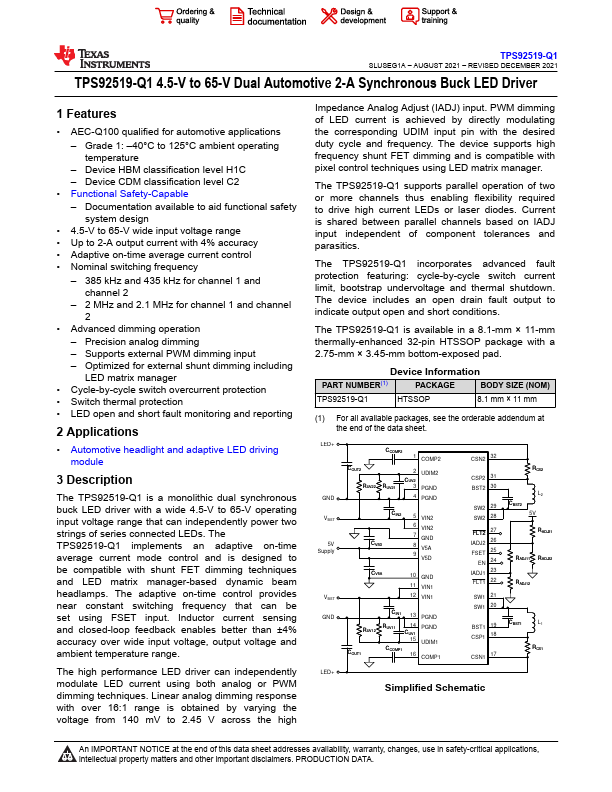
The TPS92519-Q1 is a monolithic dual synchronous buck LED driver with a wide 4.5-V to 65-V operating input voltage range that can independently power two strings of series connected LEDs. The TPS92519-Q1 implements an adaptive on-time average current mode control and is designed to be patible with shunt FET dimming techniques and LED matrix manager-based dynamic beam headlamps. The adaptive on-time control provides near constant switching frequency that can be set using FSET input. Inductor current sensing and closed-loop feedback enables better than ±4% accuracy over wide input voltage, output voltage and ambient temperature range.
The high performance LED driver can independently modulate LED current using both analog or PWM dimming techniques. Linear analog dimming response with over 16:1 range is obtained by varying the voltage from 140 m V to 2.45 V across the high
Impedance Analog Adjust (IADJ) input. PWM dimming of LED current is achieved by directly modulating the corresponding UDIM input pin with the desired duty cycle and frequency. The device supports high...