UCC3913
UCC3913 is Negative Voltage Hot Swap Power Manager manufactured by Texas Instruments.
- Part of the UCC2913 comparator family.
- Part of the UCC2913 comparator family.
FEATURES
DESCRIPTION
D Precision Fault Threshold D Programmable Average Power Limiting D Programmable Linear Current Control D Programmable Overcurrent Limit D Programmable Fault Time D Fault Output Indicator D Shutdown Control D Undervoltage Lockout D 8-Pin SOIC
APPLICATIONS D
- 48-V Distributed Power Systems D Central Office Switching D Wireless Base Stations
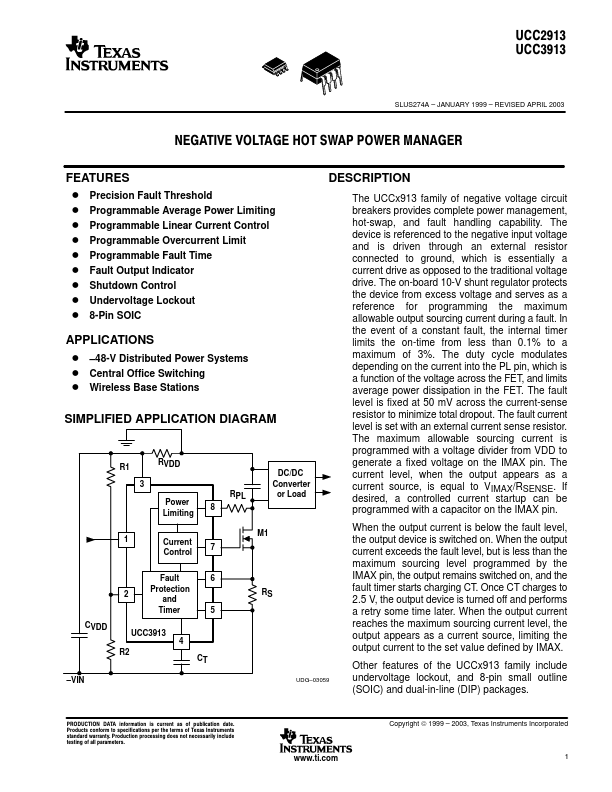
SIMPLIFIED APPLICATION DIAGRAM
R1 3
RVDD
Power Limiting
RPL 8
DC/DC Converter or Load
The UCCx913 family of negative voltage circuit breakers provides plete power management, hot-swap, and fault handling capability. The device is referenced to the negative input voltage and is driven through an external resistor connected to ground, which is essentially a current drive as opposed to the traditional voltage drive. The on-board 10-V shunt regulator protects the device from excess voltage and serves as a reference for programming the maximum allowable output sourcing current during a fault. In the event of a constant fault, the internal timer limits the on-time from less than 0.1% to a maximum of 3%. The duty cycle modulates depending on the current into the PL pin, which is a function of the voltage across the FET, and limits average power dissipation in the FET. The fault level is fixed at 50 m V across the current-sense resistor to minimize total dropout. The fault current level is set with an external current sense resistor. The maximum allowable sourcing current is programmed with a voltage divider from VDD to generate a fixed voltage on the IMAX pin. The current level, when the output appears as a current source, is equal to VIMAX/RSENSE. If desired, a controlled current startup can be programmed with a capacitor on the IMAX pin.
Current Control
CVDD
Fault
Protection and
Timer
UCC3913 4
R2 CT
- VIN
M1 When the output current is below the fault level, the output device is switched on. When the output current exceeds the fault level, but is less than the maximum sourcing level...