IW1699
IW1699 is Slot-type Photomicrosensor manufactured by iWatt.
Features
- - No-load power consumption < 30m W at 230VAC along with fast dynamic load response and short turn-on delay time in typical 12W pact adapter/charger applications
- - Tight constant-voltage and constant-current regulation across line and load range
- - Primary-side feedback eliminates opto-isolators and simplifies design
2.0 Description
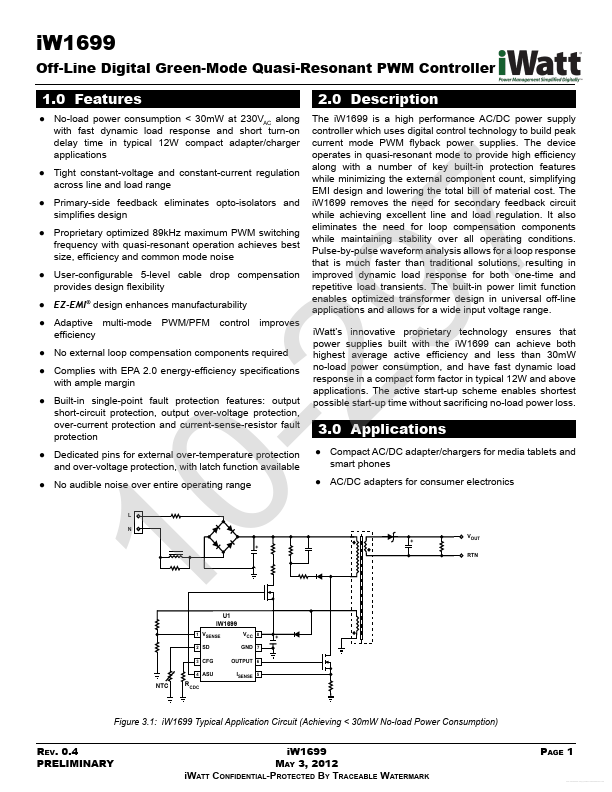
The i W1699 is a high performance AC/DC power supply controller which uses digital control technology to build peak current mode PWM flyback power supplies. The device operates in quasi-resonant mode to provide high efficiency along with a number of key built-in protection features while minimizing the external ponent count, simplifying EMI design and lowering the total bill of material cost. The i W1699 removes the need for secondary feedback circuit while achieving excellent line and load regulation. It also
- - Proprietary optimized 89k Hz maximum PWM switching frequency with quasi-resonant operation achieves best size, efficiency and mon mode noise
- - User-configurable 5-level cable drop pensation provides design flexibility
- - EZ-EMI® design enhances manufacturability
- - Adaptive multi-mode PWM/PFM control improves efficiency
- - No external loop pensation ponents required
- - plies with EPA 2.0 energy-efficiency specifications with ample margin
- - Built-in single-point fault protection features
: output short-circuit protection, output over-voltage protection, over-current protection and current-sense-resistor fault protection
- - Dedicated pins for external over-temperature protection and over-voltage protection, with latch function available
- - No audible noise over entire operating range eliminates the need for loop pensation ponents while maintaining stability over all operating conditions. Pulse-by-pulse waveform analysis allows for a loop response that is much faster than traditional solutions, resulting in improved dynamic load response for both one-time and repetitive load transients. The built-in power limit...