

Datasheet4U Logo Datasheet4U.com

74HCT4053-Q100 - Triple 2-channel analog multiplexer/demultiplexer

Download the 74HCT4053-Q100 datasheet PDF (74HC4053-Q100 included). The manufacturer datasheet provides complete specifications, pinout details, electrical characteristics, and typical applications for triple 2-channel analog multiplexer/demultiplexer.

Description

The 74HC4053-Q100; 74HCT4053-Q100 is a triple single-pole double-throw analog switch (3x SPDT) suitable for use in analog or digital 2:1 multiplexer/demultiplexer applications.

Features

  • Automotive product qualification in accordance with AEC-Q100 (Grade 1).
  • Specified from -40 °C to +85 °C and from -40 °C to +125 °C.
  • Wide analog input voltage range from -5 V to +5 V.
  • Low ON resistance:.
  • 80 Ω (typical) at VCC - VEE = 4.5 V.
  • 70 Ω (typical) at VCC - VEE = 6.0 V.
  • 60 Ω (typical) at VCC - VEE = 9.0 V.
  • Logic level translation: to enable 5 V logic to communicate with ±5 V analog signals.
  • Typical ‘break bef.

📥 Download Datasheet

Note: The manufacturer provides a single datasheet file (74HC4053-Q100-nexperia.pdf) that lists specifications for multiple related part numbers.

Datasheet Details

Part number 74HCT4053-Q100
Manufacturer nexperia
File Size 361.25 KB
Description Triple 2-channel analog multiplexer/demultiplexer
Datasheet download datasheet 74HCT4053-Q100 Datasheet
Other Datasheets by nexperia

Full PDF Text Transcription

Click to expand full text
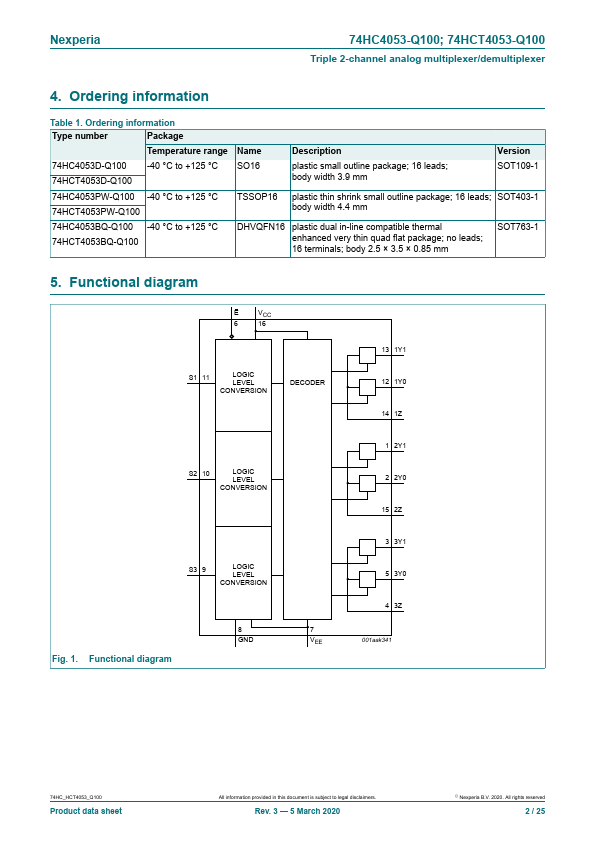
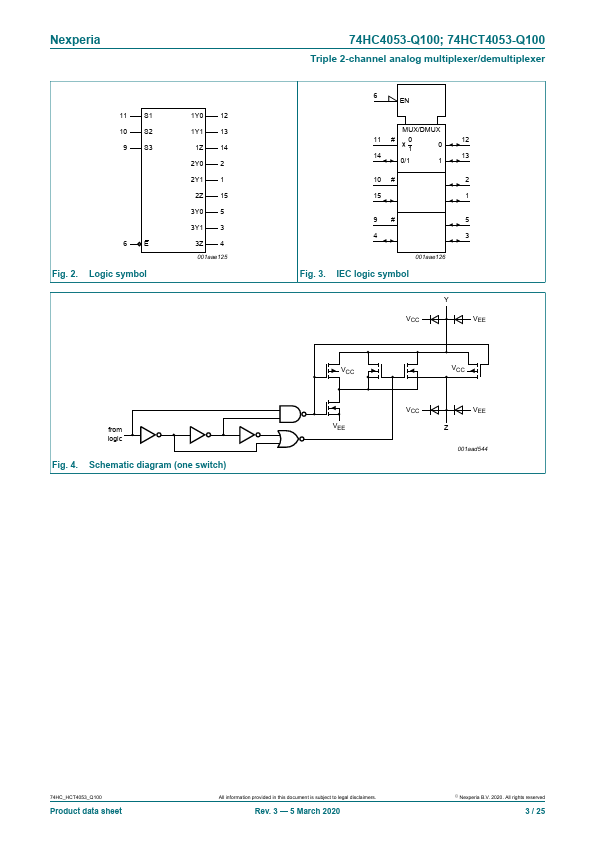
74HC4053-Q100; 74HCT4053-Q100 Triple 2-channel analog multiplexer/demultiplexer Rev. 3 — 5 March 2020 Product data sheet 1. General description The 74HC4053-Q100; 74HCT4053-Q100 is a triple single-pole double-throw analog switch (3x SPDT) suitable for use in analog or digital 2:1 multiplexer/demultiplexer applications. Each switch features a digital select input (Sn), two independent inputs/outputs (nY0 and nY1) and a common input/output (nZ). A digital enable input (E) is common to all switches. When E is HIGH, the switches are turned off. Inputs include clamp diodes. This enables the use of current limiting resistors to interface inputs to voltages in excess of VCC.
Published: |