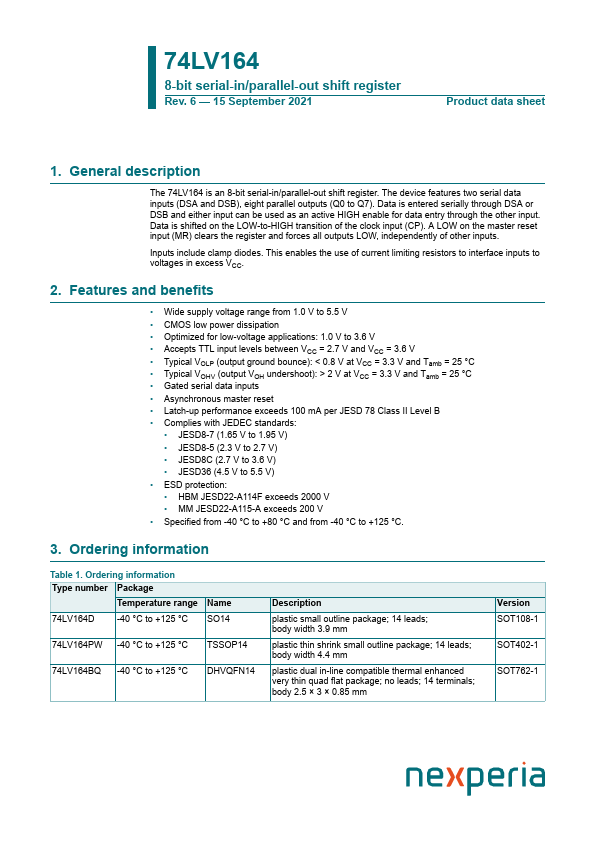
74LV164
74LV164 is 8-bit serial-in/parallel-out shift register manufactured by Nexperia.
description
The 74LV164 is an 8-bit serial-in/parallel-out shift register. The device features two serial data inputs (DSA and DSB), eight parallel outputs (Q0 to Q7). Data is entered serially through DSA or DSB and either input can be used as an active HIGH enable for data entry through the other input. Data is shifted on the LOW-to-HIGH transition of the clock input (CP). A LOW on the master reset input (MR) clears the register and forces all outputs LOW, independently of other inputs.
Inputs include clamp diodes. This enables the use of current limiting resistors to interface inputs to voltages in excess VCC.
2. Features and benefits
- Wide supply voltage range from 1.0 V to 5.5 V
- CMOS low power dissipation
- Optimized for low-voltage applications: 1.0 V to 3.6 V
- Accepts TTL input levels between VCC = 2.7 V and VCC = 3.6 V
- Typical VOLP (output ground bounce): < 0.8 V at VCC = 3.3 V and Tamb = 25 °C
- Typical VOHV (output VOH undershoot): > 2 V at VCC = 3.3 V and Tamb = 25 °C
- Gated serial data inputs
- Asynchronous master reset
- Latch-up performance exceeds 100 m A per JESD 78 Class II Level B
- plies with JEDEC standards:
- JESD8-7 (1.65 V to 1.95 V)
- JESD8-5 (2.3 V to 2.7 V)
- JESD8C (2.7 V to 3.6 V)
- JESD36 (4.5 V to 5.5 V)
- ESD protection:
- HBM JESD22-A114F exceeds 2000 V
- MM JESD22-A115-A exceeds 200 V
- Specified from -40 °C to +80 °C and from -40 °C to +125 °C.
3. Ordering information
Table 1. Ordering information Type number Package
Temperature range Name 74LV164D -40 °C to +125 °C SO14
74LV164PW -40 °C to +125 °C TSSOP14
74LV164BQ -40 °C to +125 °C DHVQFN14
Description plastic small outline package; 14 leads; body width 3.9 mm plastic thin shrink small outline package; 14 leads; body width 4.4 mm plastic dual in-line patible thermal enhanced very thin quad flat package; no leads; 14 terminals; body 2.5 × 3 × 0.85 mm
Version SOT108-1
SOT402-1
SOT762-1
Nexperia
4. Functional diagram
DSA 1 DSB 2
CP MR
Fig. 1. Logic symbol
3 Q0 4 Q1 5 Q2...