ACS712
ACS712 is Fully Integrated / Hall Effect-Based Linear Current Sensor manufactured by Allegro MicroSystems.
Fully Integrated, Hall-Effect-Based Linear Current Sensor IC with 2.4 k VRMS Isolation and a Low-Resistance Current Conductor
Features
AND BENEFITS
- Low-noise analog signal path
- Device bandwidth is set via the new FILTER pin
- 5 µs output rise time in response to step input current
- 80 k Hz bandwidth
- Total output error 1.5% at TA = 25°C
- Small footprint, low-profile SOIC-8 package
- 1.2 mΩ internal conductor resistance
- 2.4 k VRMS minimum isolation voltage from pins 1-4 to pins 5-8
- 5.0 V, single supply operation
- 66 to 185 m V/A output sensitivity
- Output voltage proportional to AC or DC currents
- Factory-trimmed for accuracy
- Extremely stable output offset voltage
- Nearly zero magnetic hysteresis
- Ratiometric output from supply voltage
TÜV America Certificate Number: U8V 15 05 54214 038 CB 13 06 54214 026
PACKAGE: 8-Lead SOIC (suffix LC)
DESCRIPTION
The Allegro™ ACS712 provides economical and precise solutionsfor ACor DCcurrentsensinginindustrial, mercial, and munications systems. The device package allows for easy implementation by the customer. Typical applications include motor control, load detection and management, switchmode power supplies, and overcurrent fault protection. The device is not intended for automotive applications.
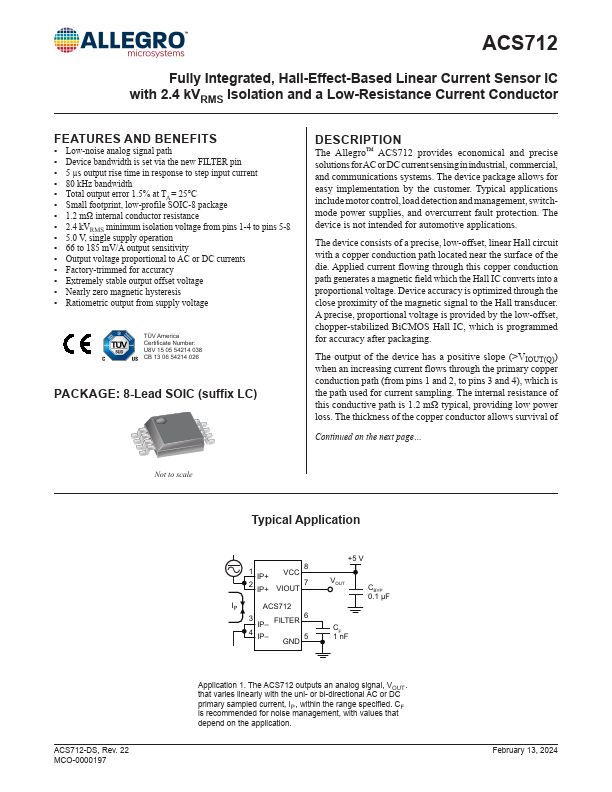
The device consists of a precise, low-offset, linear Hall circuit with a copper conduction path located near the surface of the die. Applied current flowing through this copper conduction path generates a magnetic field which the Hall IC converts into a proportional voltage. Device accuracy is optimized through the close proximity of the magnetic signal to the Hall transducer. A precise, proportional voltage is provided by the low-offset, chopper-stabilized Bi CMOS Hall IC, which is programmed for accuracy after packaging.
The output of the device has a positive slope (>VIOUT(Q)) when an increasing current flows through the primary copper conduction path (from pins 1 and 2, to pins 3 and 4), which is the path...