Datasheet4U Logo Datasheet4U.com

HMC305ALP4E - 0.5dB LSB GaAs MMIC 5-BIT SERIAL CONTROL DIGITAL ATTENUATOR

This page provides the datasheet information for the HMC305ALP4E, a member of the HMC305ALP4 0.5dB LSB GaAs MMIC 5-BIT SERIAL CONTROL DIGITAL ATTENUATOR family.

Datasheet Summary

Description

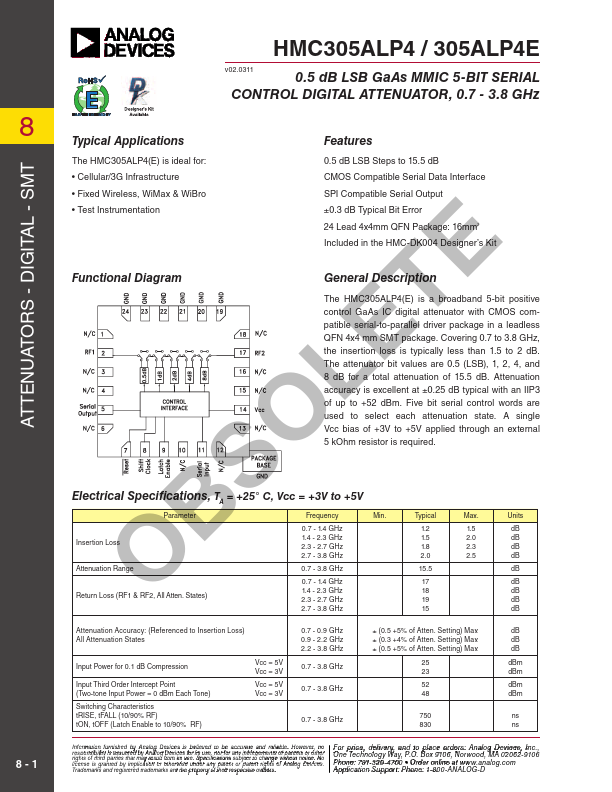
The HMC305ALP4(E) is a broadband 5-bit positive control GaAs IC digital attenuator with CMOS compatible serial-to-parallel driver package in a leadless QFN 4x4 mm SMT package.

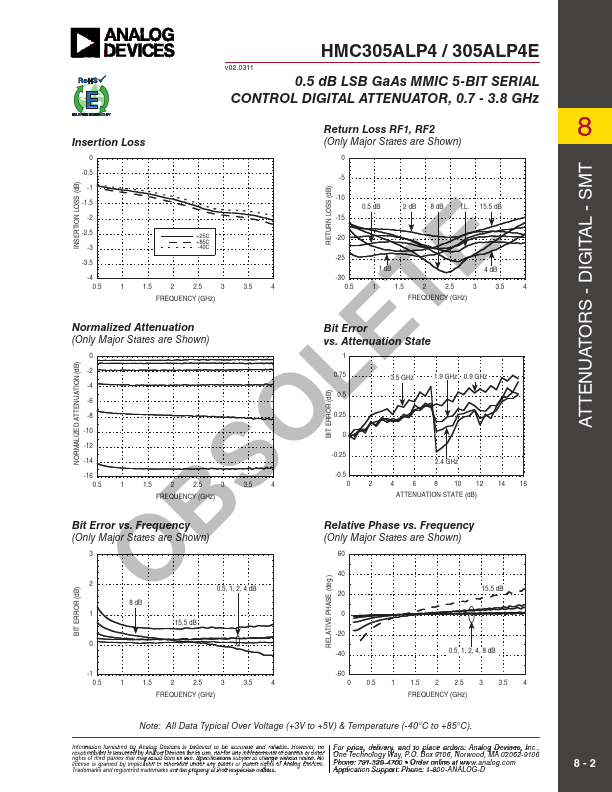
Covering 0.7 to 3.8 GHz, the insertion loss is typically less than 1.5 to 2 dB.

Features

  • The HMC305ALP4(E) is ideal for:.
  • Cellular/3G Infrastructure.
  • Fixed Wireless, WiMax & WiBro.
  • Test Instrumentation 0.5 dB LSB Steps to 15.5 dB CMOS Compatible Serial Data Interface SPI Compatible Serial Output ±0.3 dB Typical Bit Error 24 Lead 4x4mm QFN Package: 16mm² Included in the HMC-DK004 Designer’s Kit Functional Diagram General.

📥 Download Datasheet

Datasheet preview – HMC305ALP4E

Datasheet Details

Part number HMC305ALP4E
Manufacturer Analog Devices
File Size 1.52 MB
Description 0.5dB LSB GaAs MMIC 5-BIT SERIAL CONTROL DIGITAL ATTENUATOR
Datasheet download datasheet HMC305ALP4E Datasheet
Additional preview pages of the HMC305ALP4E datasheet.
Other Datasheets by Analog Devices

Full PDF Text Transcription

Click to expand full text
Attenuators - DIGITAL - SMT OBSOLETE HMC305ALP4 / 305ALP4E v02.0311 0.5 dB LSB GaAs MMIC 5-BIT SERIAL CONTROL DIGITAL ATTENUATOR, 0.7 - 3.8 GHz 8 Typical Applications Features The HMC305ALP4(E) is ideal for: • Cellular/3G Infrastructure • Fixed Wireless, WiMax & WiBro • Test Instrumentation 0.5 dB LSB Steps to 15.5 dB CMOS Compatible Serial Data Interface SPI Compatible Serial Output ±0.3 dB Typical Bit Error 24 Lead 4x4mm QFN Package: 16mm² Included in the HMC-DK004 Designer’s Kit Functional Diagram General Description The HMC305ALP4(E) is a broadband 5-bit positive control GaAs IC digital attenuator with CMOS compatible serial-to-parallel driver package in a leadless QFN 4x4 mm SMT package. Covering 0.7 to 3.8 GHz, the insertion loss is typically less than 1.5 to 2 dB.
Published: |