• Part: IS61LPD102418A
  • Description: 512K x 36 - 1024K x 18 18Mb SYNCHRONOUS PIPELINED DOUBLE CYCLE DESELECT STATIC RAM
  • Manufacturer: ISSI
  • Size: 251.04 KB
Download IS61LPD102418A Datasheet PDF
ISSI
IS61LPD102418A
IS61LPD102418A is 512K x 36 - 1024K x 18 18Mb SYNCHRONOUS PIPELINED DOUBLE CYCLE DESELECT STATIC RAM manufactured by ISSI.
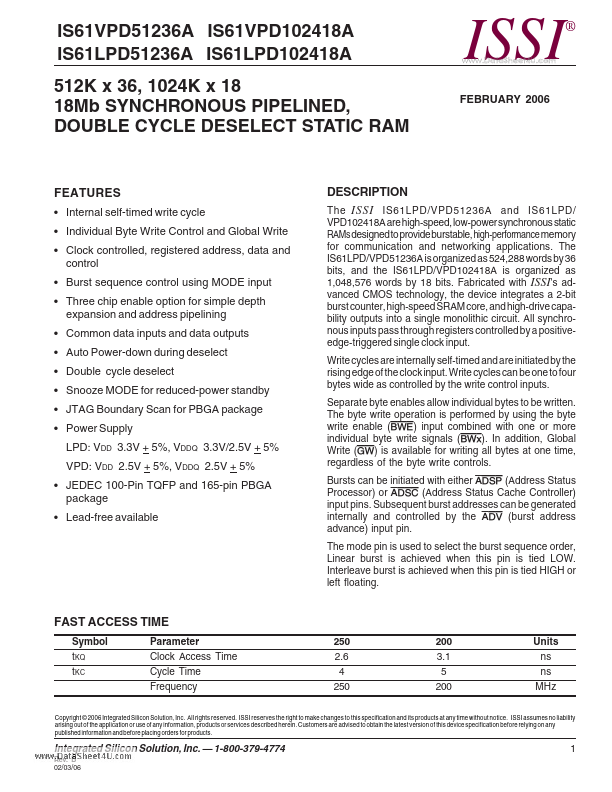
FEATURES - Internal self-timed write cycle - Individual Byte Write Control and Global Write - Clock controlled, registered address, data and control - Burst sequence control using MODE input - Three chip enable option for simple depth expansion and address pipelining - mon data inputs and data outputs - Auto Power-down during deselect - Double cycle deselect - Snooze MODE for reduced-power standby - JTAG Boundary Scan for PBGA package - Power Supply LPD: VDD 3.3V + 5%, VDDQ 3.3V/2.5V + 5% VPD: VDD 2.5V + 5%, VDDQ 2.5V + 5% - JEDEC 100-Pin TQFP and 165-pin PBGA package - Lead-free available DESCRIPTION The ISSI IS61LPD/VPD51236A and IS61LPD/ VPD102418A are high-speed, low-power synchronous static RAMs designed to provide burstable, high-performance memory for munication and networking applications. The IS61LPD/VPD51236A is organized as 524,288 words by 36 bits, and the IS61LPD/VPD102418A is organized as 1,048,576 words by 18 bits. Fabricated with ISSI's advanced CMOS technology, the device integrates a 2-bit burst counter, high-speed SRAM core, and high-drive capability outputs into a single monolithic circuit. All synchronous inputs pass through registers controlled by a positiveedge-triggered single clock input. Write cycles are internally self-timed and are initiated by the rising edge of the clock input. Write cycles can be one to four bytes wide as controlled by the write control inputs. Separate byte enables allow individual bytes to be written. The byte write operation is performed by using the byte write enable (BWE) input bined with one or more individual byte write signals (BWx). In addition, Global Write (GW) is available for writing all bytes at one time, regardless of the byte write controls. Bursts can be initiated with either ADSP (Address Status Processor) or ADSC (Address Status Cache Controller) input pins. Subsequent burst addresses can be generated internally and controlled by the ADV (burst address advance) input pin. The mode pin is used to...