

ATA6562
ATA6562 is High-Speed CAN Transceiver manufactured by Microchip Technology.
Features
- Fully ISO 11898-2, ISO 11898-2: 2016 and SAE J2962-2 pliant
- CAN FD Ready
- munication Speed up to 5 Mbps
- ISO 26262 Functional Safety Ready
- Low Electromagnetic Emission (EME) and High
Electromagnetic Immunity (EMI)
- Differential Receiver with Wide mon-Mode
Range
- ATA6562: Silent Mode
- Remote Wake-Up Capability via CAN Bus
- Wake-Up on Pattern (WUP), as Specified in ISO 11898-2: 2016, 3.8 µs Activity Filter Time
- Functional Behavior Predictable under All Supply Conditions
- Transceiver Disengages from the Bus When Not Powered Up
- RXD Recessive Clamping Detection
- High Electrostatic Discharge (ESD) Handling Capability on the Bus Pins
- Bus Pins Protected Against Transients in Automotive Environments
- Transmit Data (TXD) Dominant Time-Out Function
- Undervoltage Detection on VCC and VIO Pins
- CANH/CANL Short-Circuit and Overtemperature Protected
- Fulfills the OEM “Hardware Requirements for LIN, CAN and Flex Ray Interfaces in Automotive Applications”, Rev. 1.3
- AEC-Q100 and AEC-Q006 Qualified
- Two Ambient Temperature Grades Available:
- ATA6562-GAQW1, ATA6563-GAQW1,
ATA6562-GBQW1 and ATA6563-GBQW1 up to Tamb = +125°C
- ATA6562-GAQW0, ATA6563-GAQW0, ATA6562-GBQW0 and ATA6563-GBQW0 up to Tamb = +150°C
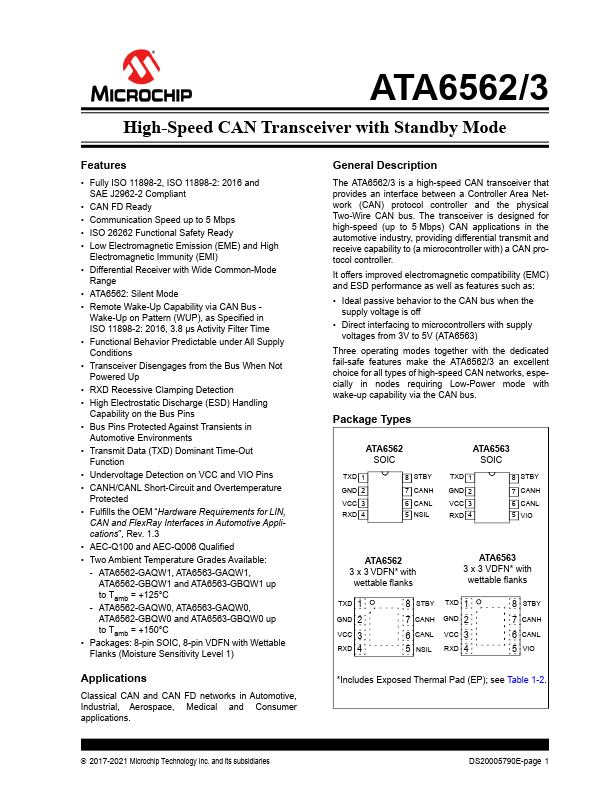
- Packages: 8-pin SOIC, 8-pin VDFN with Wettable Flanks (Moisture Sensitivity Level 1)
Applications
Classical CAN and CAN FD networks in Automotive, Industrial, Aerospace, Medical and Consumer applications.
General Description
The ATA6562/3 is a high-speed CAN transceiver that provides an interface between a Controller Area Network (CAN) protocol controller and the physical Two-Wire CAN bus. The transceiver is designed for high-speed (up to 5 Mbps) CAN applications in the automotive industry, providing differential transmit and receive capability to (a microcontroller with) a CAN protocol controller.
It offers improved electromagnetic patibility (EMC) and ESD performance as well as features such as:
- Ideal passive behavior to the CAN bus when the...