Datasheet4U Logo Datasheet4U.com

27C64 - UV Erasable CMOS PROM

Datasheet Summary

Description

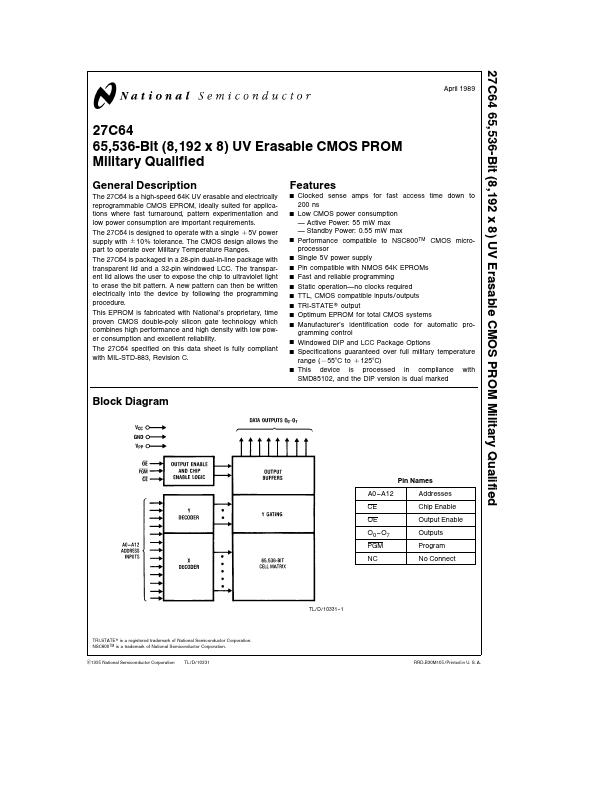
The 27C64 is a high-speed 64K UV erasable and electrically reprogrammable CMOS EPROM ideally suited for applications where fast turnaround pattern experimentation and low power consumption are important requirements The 27C64 is designed to operate with a single a5V power supply with g10% tolerance

Features

  • Y Clocked sense amps for fast access time down to 200 ns Y Low CMOS power consumption Active Power 55 mW max Standby Power 0 55 mW max Y Performance compatible to NSC800TM CMOS microprocessor Y Single 5V power supply Y Pin compatible with NMOS 64K EPROMs Y Fast and reliable programming Y Static operation no clocks required Y TTL CMOS compatible inputs outputs Y TRI-STATE output Y Optimum EPROM for total CMOS systems Y Manufacturer’s identification code for automatic pro- gramming control Y Windo.

📥 Download Datasheet

Datasheet preview – 27C64

Datasheet Details

Part number 27C64
Manufacturer National Semiconductor
File Size 166.33 KB
Description UV Erasable CMOS PROM
Datasheet download datasheet 27C64 Datasheet
Additional preview pages of the 27C64 datasheet.
Other Datasheets by National Semiconductor

Full PDF Text Transcription

Click to expand full text
27C64 65 536-Bit (8 192 x 8) UV Erasable CMOS PROM Military Qualified April 1989 27C64 65 536-Bit (8 192 x 8) UV Erasable CMOS PROM Military Qualified General Description The 27C64 is a high-speed 64K UV erasable and electrically reprogrammable CMOS EPROM ideally suited for applications where fast turnaround pattern experimentation and low power consumption are important requirements The 27C64 is designed to operate with a single a5V power supply with g10% tolerance The CMOS design allows the part to operate over Military Temperature Ranges The 27C64 is packaged in a 28-pin dual-in-line package with transparent lid and a 32-pin windowed LCC The transparent lid allows the user to expose the chip to ultraviolet light to erase the bit pattern A new pattern can then be written electrically
Published: |