
Datasheet Details
| Part number | LP2951 |
|---|---|
| Manufacturer | National Semiconductor (Texas Instruments) |
| File Size | 724.25 KB |
| Description | Micropower Voltage Regulators |
| Datasheet |
 LP2951 Datasheet LP2951 Datasheet
|
|
|

Download the LP2951 datasheet PDF. This datasheet also covers the LP2951ACS variant, as both devices belong to the same micropower voltage regulators family and are provided as variant models within a single manufacturer datasheet.
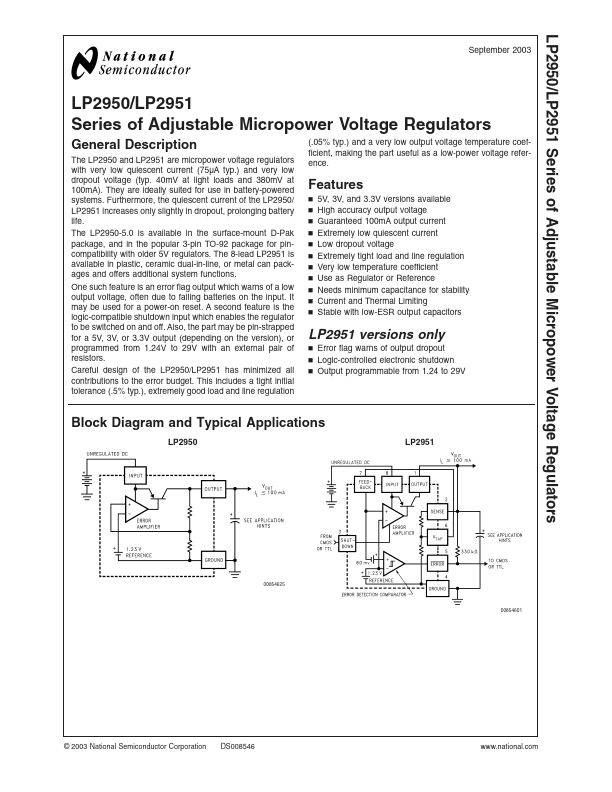
The LP2950 and LP2951 are micropower voltage regulators with very low quiescent current (75µA typ.) and very low dropout voltage (typ.
40mV at light loads and 380mV at 100mA).
They are ideally suited for use in battery-powered systems.
| Part number | LP2951 |
|---|---|
| Manufacturer | National Semiconductor (Texas Instruments) |
| File Size | 724.25 KB |
| Description | Micropower Voltage Regulators |
| Datasheet |
LP2951 Datasheet
|
|
|
|
| Part Number | Description | Manufacturer |
|---|---|---|
| LP2951 | 150mA ADJUSTABLE VOLTAGE REGULATOR | Semtech Corporation |
| LP2951 | Adjustable Micro Power Voltage Regulator | Fairchild Semiconductor |
| LP2951 | 100mA Low-Dropout Voltage Regulator | Micrel Semiconductor |
| LP2951 | Low Dropout Voltage Regulators | MaxLinear |
| LP2951 | LOW DROPOUT VOLTAGE REGULATORS | Exar |
| Part Number | Description |
|---|---|
| LP2950 | Micropower Voltage Regulators |
| LP2952 | Adjustable Micropower Low-Dropout Voltage Regulators |
| LP2952A | Adjustable Micropower Low-Dropout Voltage Regulators |
| LP2953 | Adjustable Micropower Low-Dropout Voltage Regulators |
| LP2953A | Adjustable Micropower Low-Dropout Voltage Regulators |