• Part: AP1161
  • Description: 300mA LDO Regulator
  • Category: LDO Regulator
  • Manufacturer: Asahi Kasei Microdevices
  • Size: 825.33 KB
Download AP1161 Datasheet PDF
Asahi Kasei Microdevices
AP1161
AP1161 is 300mA LDO Regulator manufactured by Asahi Kasei Microdevices.
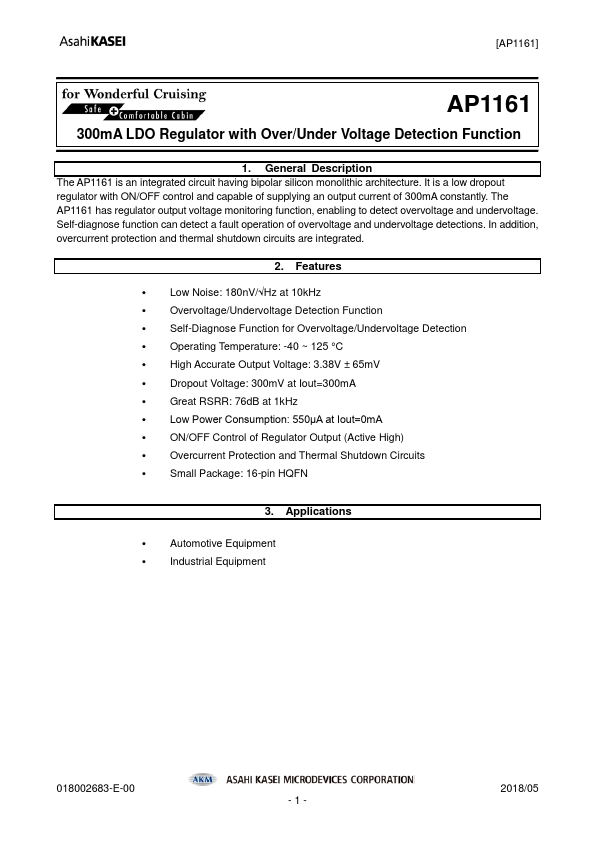
[AP1161] 300m A LDO Regulator with Over/Under Voltage Detection Function 1. General Description The AP1161 is an integrated circuit having bipolar silicon monolithic architecture. It is a low dropout regulator with ON/OFF control and capable of supplying an output current of 300m A constantly. The AP1161 has regulator output voltage monitoring function, enabling to detect overvoltage and undervoltage. Self-diagnose function can detect a fault operation of overvoltage and undervoltage detections. In addition, overcurrent protection and thermal shutdown circuits are integrated. 2. Features - Low Noise: 180n V/√Hz at 10k Hz - Overvoltage/Undervoltage Detection Function - Self-Diagnose Function for Overvoltage/Undervoltage Detection - Operating Temperature: -40 ~ 125 °C - High Accurate Output Voltage: 3.38V ± 65m V - Dropout Voltage: 300m V at Iout=300m A - Great RSRR: 76d B at 1k Hz - Low Power Consumption: 550μA at Iout=0m A - ON/OFF Control of Regulator Output (Active High) - Overcurrent Protection and Thermal Shutdown Circuits - Small Package: 16-pin HQFN 3. Applications - Automotive Equipment - Industrial Equipment 018002683-E-00 -1- 2018/05 [AP1161] 4. Table of Contents 1. General Description ............................................................................................................................ 1 2. Features .............................................................................................................................................. 1 3. Applications......................................................................................................................................... 1 4. Table of Contents ................................................................................................................................ 2 5. Block Diagram and Functions ............................................................................................................. 3 6. Pin Configurations and Functions...................