

Datasheet4U Logo Datasheet4U.com

ALD910030 - QUAD/DUAL SUPERCAPACITOR AUTO BALANCING MOSFET ARRAY

This page provides the datasheet information for the ALD910030, a member of the ALD810030 QUAD/DUAL SUPERCAPACITOR AUTO BALANCING MOSFET ARRAY family.

Description

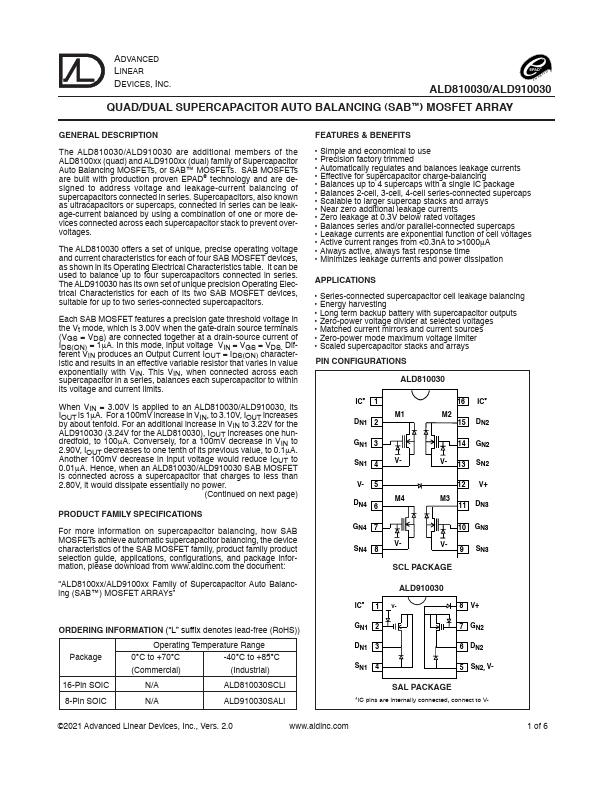
The ALD810030/ALD910030 are additional members of the ALD8100xx (quad) and ALD9100xx (dual) family of Supercapacitor Auto Balancing MOSFETs, or SAB™ MOSFETs.

Features

  • a precision gate threshold voltage in the Vt mode, which is 3.00V when the gate-drain source terminals (VGS = VDS) are connected together at a drain-source current of IDS(ON) = 1µA. In this mode, input voltage VIN = VGS = VDS. Different VIN produces an Output Current IOUT = IDS(ON) characteristic and results in an effective variable resistor that varies in value exponentially with VIN. This VIN, when connected across each supercapacitor in a series, balances each supercapacitor to within its vol.

📥 Download Datasheet

Datasheet preview – ALD910030

Datasheet Details

Part number ALD910030
Manufacturer Advanced Linear Devices
File Size 443.94 KB
Description QUAD/DUAL SUPERCAPACITOR AUTO BALANCING MOSFET ARRAY
Datasheet download datasheet ALD910030 Datasheet
Additional preview pages of the ALD910030 datasheet.
Other Datasheets by Advanced Linear Devices

Full PDF Text Transcription

Click to expand full text
ADVANCED LINEAR DEVICES, INC. e TM EPAD ENA ® B L E D ALD810030/ALD910030 QUAD/DUAL SUPERCAPACITOR AUTO BALANCING (SAB™) MOSFET ARRAY GENERAL DESCRIPTION The ALD810030/ALD910030 are additional members of the ALD8100xx (quad) and ALD9100xx (dual) family of Supercapacitor Auto Balancing MOSFETs, or SAB™ MOSFETs. SAB MOSFETs are built with production proven EPAD® technology and are designed to address voltage and leakage-current balancing of supercapacitors connected in series. Supercapacitors, also known as ultracapacitors or supercaps, connected in series can be leakage-current balanced by using a combination of one or more devices connected across each supercapacitor stack to prevent overvoltages.
Published: |