ATS651LSH
ATS651LSH is Two-Wire Self-Calibrating Differential Speed and Direction Sensor manufactured by Allegro MicroSystems.
FEATURES
AND BENEFITS
- Rotational direction detection
- Fully optimized digital differential gear-tooth sensor IC
- Single-chip sensing IC for high reliability
- Small mechanical size (8 mm diameter × 5.5 mm vertical, flat-to-flat)
- Internal current regulator for 2-wire operation
- Automatic Gain Control (AGC) and reference adjust circuit
- 3-bit factory-trimmed for tight pulse width accuracy
- True zero-speed operation
- Wide operating voltage range
- Undervoltage lockout
- Defined power-on state
- ESD and reverse polarity protection
PACKAGE: 4-pin SIP (suffix SH)
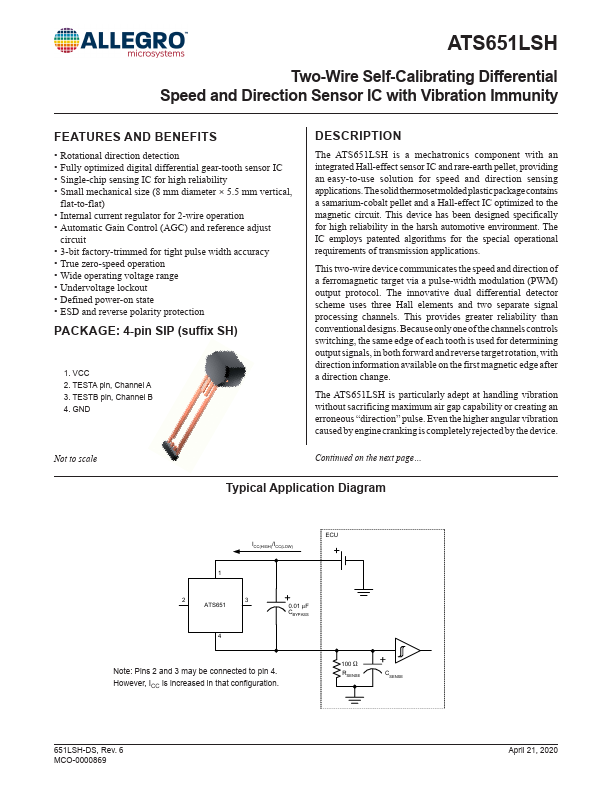
1. VCC 2. TESTA pin, Channel A 3. TESTB pin, Channel B 4. GND
DESCRIPTION
The ATS651LSH is a mechatronics ponent with an integrated Hall-effect sensor IC and rare-earth pellet, providing an easy-to-use solution for speed and direction sensing applications. The solid thermoset molded plastic package contains a samarium-cobalt pellet and a Hall-effect IC optimized to the magnetic circuit. This device has been designed specifically for high reliability in the harsh automotive environment. The IC employs patented algorithms for the special operational requirements of transmission applications.
This two-wire device municates the speed and direction of a ferromagnetic target via a pulse-width modulation (PWM) output protocol. The innovative dual differential detector scheme uses three Hall elements and two separate signal processing channels. This provides greater reliability than conventional designs. Because only one of the channels controls switching, the same edge of each tooth is used for determining output signals, in both forward and reverse target rotation, with direction information available on the first magnetic edge after a direction change.
The ATS651LSH is particularly adept at handling vibration without sacrificing maximum air gap capability or creating an erroneous “direction” pulse. Even the higher angular vibration caused by engine cranking is pletely rejected by the device.
Not to...