A80603-1
Description
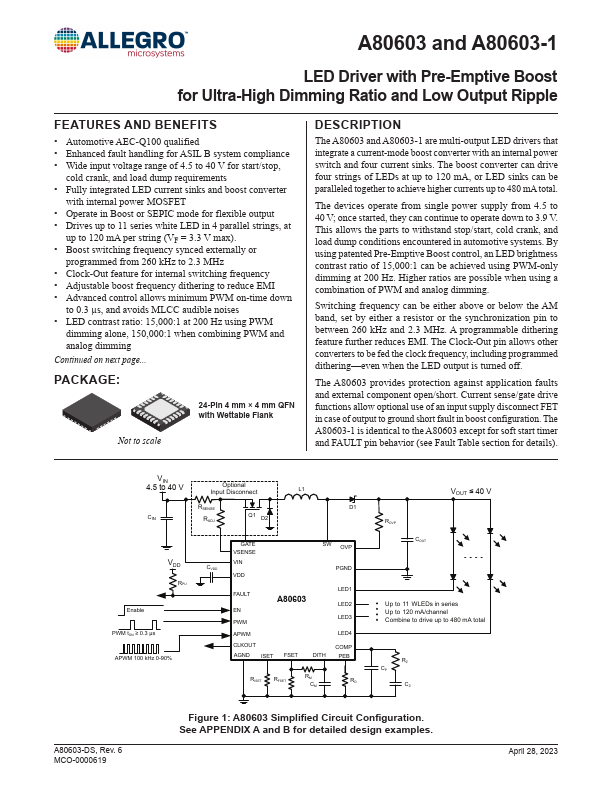
The A80603 and A80603-1 are multi-output LED drivers that integrate a current-mode boost converter with an internal power switch and four current sinks. The boost converter can drive four strings of LEDs at up to 120 mA, or LED sinks can be paralleled together to achieve higher currents up to 480 mA total.
Key Features
- Automotive AEC-Q100 qualified
- Enhanced fault handling for ASIL B system compliance
- Wide input voltage range of 4.5 to 40 V for start/stop, cold crank, and load dump requirements
- Fully integrated LED current sinks and boost converter with internal power MOSFET
- Operate in Boost or SEPIC mode for flexible output
- Drives up to 11 series white LED in 4 parallel strings, at up to 120 mA per string (VF = 3.3 V max).
- Boost switching frequency synced externally or programmed from 260 kHz to 2.3 MHz
- Clock-Out feature for internal switching frequency
- Adjustable boost frequency dithering to reduce EMI
- Advanced control allows minimum PWM on-time down to 0.3 µs, and avoids MLCC audible noises