A80606-1
A80606-1 is High Power LED Driver manufactured by Allegro MicroSystems.
- Part of the A80606 comparator family.
A80606 and A80606-1
High Power LED Driver with Pre-Emptive Boost for Ultra-High Dimming Ratio and Low Output Ripple
Features
AND BENEFITS
- Automotive AEC-Q100 qualified
- Enhanced fault handling for ASIL B system pliance
- Wide input voltage range of 4.5 to 40 V for start/stop, cold crank, and load dump requirements
- Operate in Boost or SEPIC mode for flexible output
- Gate driver for external MOSFET to deliver higher output power
- Six integrated LED current sinks, up to 180 m A each
- Boost switching frequency synced externally or programmed from 260 k Hz to 2.3 MHz
- Programmable boost frequency dithering to reduce EMI
- Advanced control allows minimum PWM on-time down to 0.3 µs, and avoids MLCC audible noises
- LED contrast ratio: 15,000:1 at 200 Hz using PWM dimming alone, 150,000:1 when bining PWM and analog dimming
- Excellent input voltage transient response even at lowest PWM duty cycle
Continued on next page...
PACKAGE:
48-Pin 7 mm × 7 mm QFN with Wettable Flank
Not to scale
DESCRIPTION
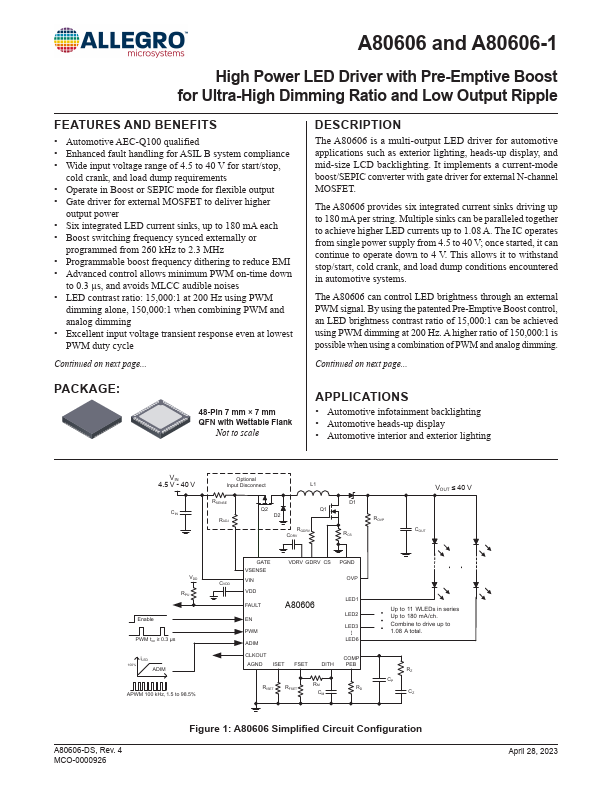
The A80606 is a multi-output LED driver for automotive applications such as exterior lighting, heads-up display, and mid-size LCD backlighting. It implements a current-mode boost/SEPIC converter with gate driver for external N-channel MOSFET.
The A80606 provides six integrated current sinks driving up to 180 m A per string. Multiple sinks can be paralleled together to achieve higher LED currents up to 1.08 A. The IC operates from single power supply from 4.5 to 40 V; once started, it can continue to operate down to 4 V. This allows it to withstand stop/start, cold crank, and load dump conditions encountered in automotive systems.
The A80606 can control LED brightness through an external PWM signal. By using the patented Pre-Emptive Boost control, an LED brightness contrast ratio of 15,000:1 can be achieved using PWM dimming at 200 Hz. A higher ratio of 150,000:1 is possible when using a bination of PWM and analog dimming.
Continued on next page...
APPLICATIONS...