A89306
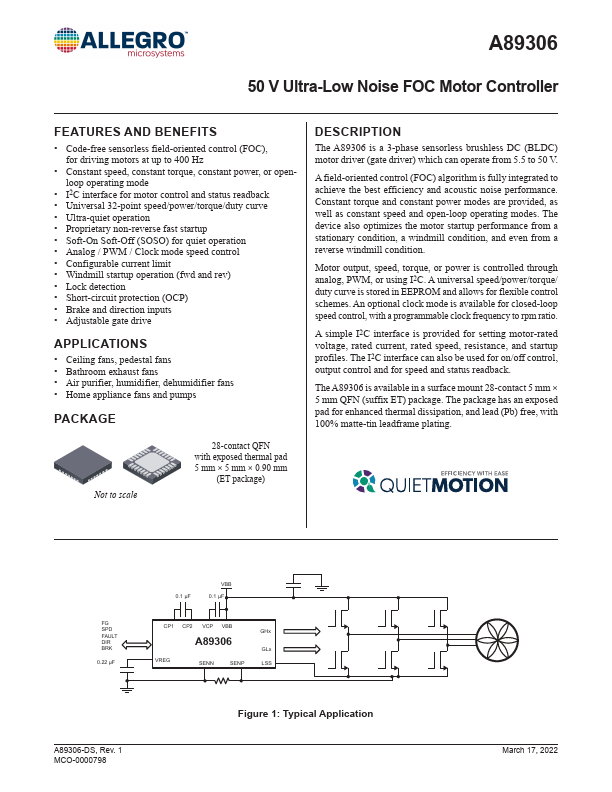
A89306 is 50V Ultra-Low Noise FOC Motor Controller manufactured by Allegro MicroSystems.
Features
AND BENEFITS
- Code-free sensorless field-oriented control (FOC), for driving motors at up to 400 Hz
- Constant speed, constant torque, constant power, or openloop operating mode
- I2C interface for motor control and status readback
- Universal 32-point speed/power/torque/duty curve
- Ultra-quiet operation
- Proprietary non-reverse fast startup
- Soft-On Soft-Off (SOSO) for quiet operation
- Analog / PWM / Clock mode speed control
- Configurable current limit
- Windmill startup operation (fwd and rev)
- Lock detection
- Short-circuit protection (OCP)
- Brake and direction inputs
- Adjustable gate drive
APPLICATIONS
- Ceiling fans, pedestal fans
- Bathroom exhaust fans
- Air purifier, humidifier, dehumidifier fans
- Home appliance fans and pumps
PACKAGE
Not to scale
28-contact QFN with exposed thermal pad 5 mm × 5 mm × 0.90 mm
(ET package)
DESCRIPTION
The A89306 is a 3-phase sensorless brushless DC (BLDC) motor driver (gate driver) which can operate from 5.5 to 50 V.
A field-oriented control (FOC) algorithm is fully integrated to achieve the best efficiency and acoustic noise performance. Constant torque and constant power modes are provided, as well as constant speed and open-loop operating modes. The device also optimizes the motor startup performance from a stationary condition, a windmill condition, and even from a reverse windmill condition.
Motor output, speed, torque, or power is controlled through analog, PWM, or using I2C. A universal speed/power/torque/ duty curve is stored in EEPROM and allows for flexible control schemes. An optional clock mode is available for closed-loop speed control, with a programmable clock frequency to rpm ratio.
A simple I2C interface is provided for setting motor-rated voltage, rated current, rated speed, resistance, and startup profiles. The I2C interface can also be used for on/off control, output control and for speed and status...