Datasheet4U Logo Datasheet4U.com

BLF6H10LS-160 - Power LDMOS transistor

Download the BLF6H10LS-160 datasheet PDF. This datasheet also covers the BLF6H10L-160 variant, as both devices belong to the same power ldmos transistor family and are provided as variant models within a single manufacturer datasheet.

General Description

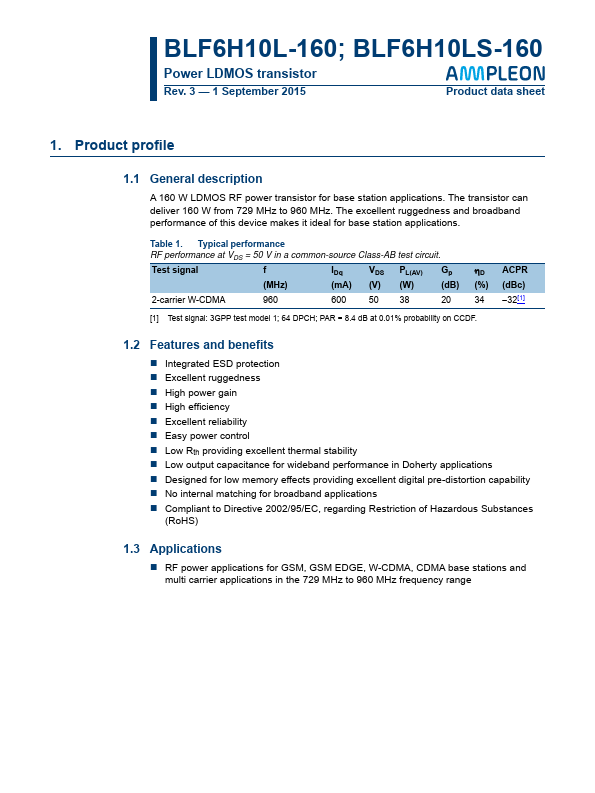
A 160 W LDMOS RF power transistor for base station applications.

The transistor can deliver 160 W from 729 MHz to 960 MHz.

The excellent ruggedness and broadband performance of this device makes it ideal for base station applications.

Key Features

  • Integrated ESD protection.
  • Excellent ruggedness.
  • High power gain.
  • High efficiency.
  • Excellent reliability.
  • Easy power control.
  • Low Rth providing excellent thermal stability.
  • Low output capacitance for wideband performance in Doherty applicati.

📥 Download Datasheet

Note: The manufacturer provides a single datasheet file (BLF6H10L-160-Ampleon.pdf) that lists specifications for multiple related part numbers.

Datasheet Details

Part number BLF6H10LS-160
Manufacturer Ampleon
File Size 367.22 KB
Description Power LDMOS transistor
Datasheet download datasheet BLF6H10LS-160 Datasheet

Full PDF Text Transcription (Reference)

The following content is an automatically extracted verbatim text from the original manufacturer datasheet and is provided for reference purposes only.

View original datasheet text
BLF6H10L-160; BLF6H10LS-160 Power LDMOS transistor Rev. 3 — 1 September 2015 Product data sheet 1. Product profile 1.1 General description A 160 W LDMOS RF power transistor for base station applications. The transistor can deliver 160 W from 729 MHz to 960 MHz. The excellent ruggedness and broadband performance of this device makes it ideal for base station applications. Table 1. Typical performance RF performance at VDS = 50 V in a common-source Class-AB test circuit. Test signal f IDq VDS PL(AV) Gp (MHz) (mA) (V) (W) (dB) 2-carrier W-CDMA 960 600 50 38 20 D (%) 34 [1] Test signal: 3GPP test model 1; 64 DPCH; PAR = 8.4 dB at 0.01% probability on CCDF. ACPR (dBc) 32[1] 1.