AD20MSP410
AD20MSP410 is GSM Baseband Processing Chipset manufactured by Analog Devices.
FEATURES
Passed European GSM Phase I Type Approval plete Baseband Processing Chipset Performs: Speech Coding/Decoding, According to GSM 06.XX DTMF and Call Progress Tone Generation Equalization with 16-State Viterbi, Soft Decision Channel Coding/Decoding According to GSM 05.03 All ADC and DAC Interface Functions Includes all Radio, Auxiliary and Voice Interfaces Support for GSM Data Services Embedded 16-Bit Microcontroller Layer 1 Software Provided with Chipset Full Phase 2 Protocol Stack Software Available Integrated SIM- and Keyboard Interface Ultralow Power Design 2.7 V Operating Voltage Intelligent Power Management Features
Up to 70 Hours Standby Time Achievable JTAG-Boundary Scan Full Reference Design Available Three TQFP Devices, Occupying Less than 12 cm2 APPLICATIONS GSM/DCS1800 Mobile Radios and PCMCIA Cards GENERAL DESCRIPTION
GSM Baseband Processing Chipset AD20msp410
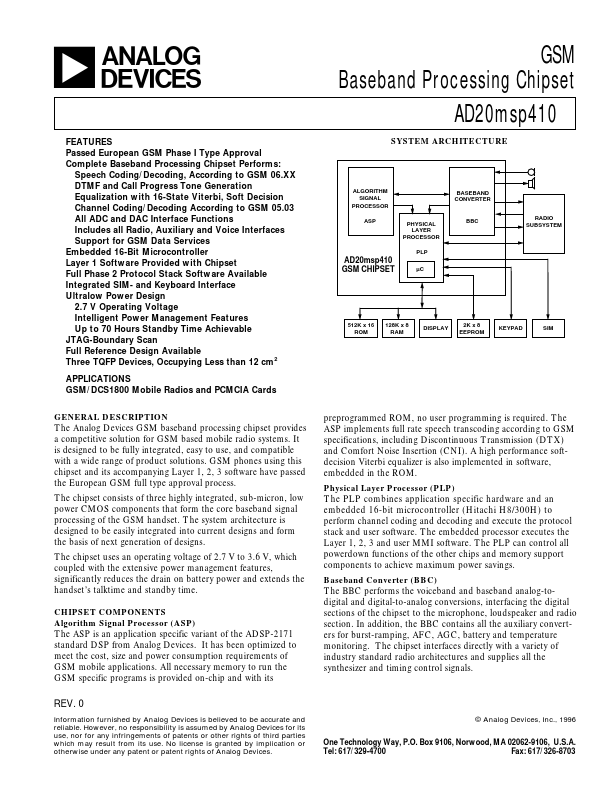
SYSTEM ARCHITECTURE
ALGORITHM SIGNAL PROCESSOR ASP PHYSICAL LAYER PROCESSOR PLP
BASEBAND CONVERTER RADIO SUBSYSTEM
AD20msp410 GSM CHIPSET
µC
512K x 16 ROM
128K x 8 RAM
DISPLAY
2K x 8 EEPROM
KEYPAD
The Analog Devices GSM baseband processing chipset provides a petitive solution for GSM based mobile radio systems. It is designed to be fully integrated, easy to use, and patible with a wide range of product solutions. GSM phones using this chipset and its acpanying Layer 1, 2, 3 software have passed the European GSM full type approval process. The chipset consists of three highly integrated, sub-micron, low power CMOS ponents that form the core baseband signal processing of the GSM handset. The system architecture is designed to be easily integrated into current designs and form the basis of next generation of designs. The chipset uses an operating voltage of 2.7 V to 3.6 V, which coupled with the extensive power management features
, significantly reduces the drain on battery power and extends the handset’s talktime and standby time.
CHIPSET PONENTS Algorithm Signal...