AD7801
AD7801 is +2.7 V to +5.5 V/ Parallel Input/ Voltage Output 8-Bit DAC manufactured by Analog Devices.
FEATURES
Single 8-Bit DAC 20-Pin SOIC/TSSOP Package +2.7 V to +5.5 V Operation Internal and External Reference Capability DAC Power-Down Function Parallel Interface On-Chip Output Buffer Rail-to-Rail Operation Low Power Operation 1.75 m A max @ 3.3 V Power-Down to 1 A max @ 25؇ C APPLICATIONS Portable Battery Powered Instruments Digital Gain and Offset Adjustment Programmable Voltage and Current Sources Programmable Attenuators
+2.7 V to +5.5 V, Parallel Input, Voltage Output 8-Bit DAC AD7801
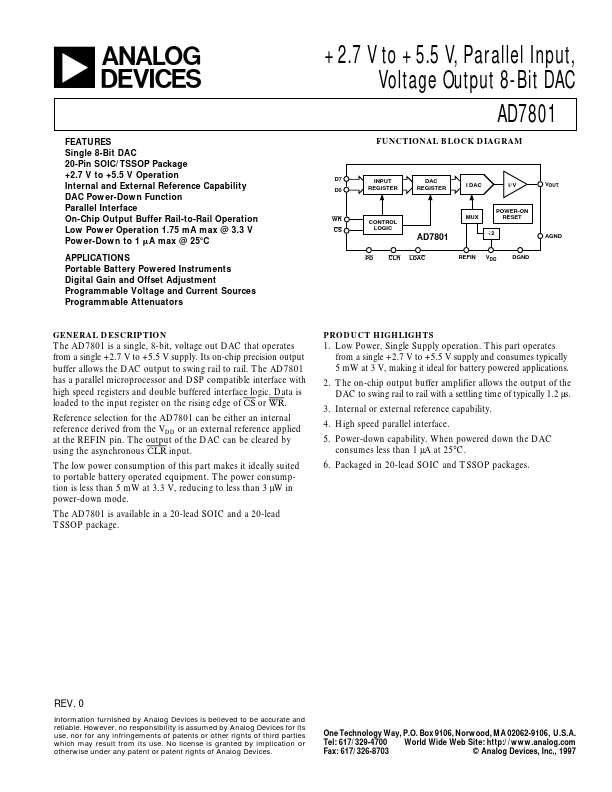
FUNCTIONAL BLOCK DIAGRAM
D7 D0 INPUT REGISTER DAC REGISTER I DAC I/V VOUT
WR CS
CONTROL LOGIC
POWER-ON RESET
PD CLR LDAC REFIN
÷2
AGND
DGND
GENERAL DESCRIPTION
PRODUCT HIGHLIGHTS
The AD7801 is a single, 8-bit, voltage out DAC that operates from a single +2.7 V to +5.5 V supply. Its on-chip precision output buffer allows the DAC output to swing rail to rail. The AD7801 has a parallel microprocessor and DSP patible interface with high speed registers and double buffered interface logic. Data is loaded to the input register on the rising edge of CS or WR. Reference selection for the AD7801 can be either an internal reference derived from the VDD or an external reference applied at the REFIN pin. The output of the DAC can be cleared by using the asynchronous CLR input. The low power consumption of this part makes it ideally suited to portable battery operated equipment. The power consumption is less than 5 m W at 3.3 V, reducing to less than 3 µW in power-down mode. The AD7801 is available in a 20-lead SOIC and a 20-lead TSSOP package.
1. Low Power, Single Supply operation. This part operates from a single +2.7 V to +5.5 V supply and consumes typically 5 m W at 3 V, making it ideal for battery powered applications. 2. The on-chip output buffer amplifier allows the output of the DAC to swing rail to rail with a settling time of typically 1.2 µs. 3. Internal or external reference capability. 4. High speed parallel interface. 5. Power-down capability. When...