Datasheet4U Logo Datasheet4U.com

AD8112 - fully buffered crosspoint switch matrix that operates

Datasheet Summary

Description

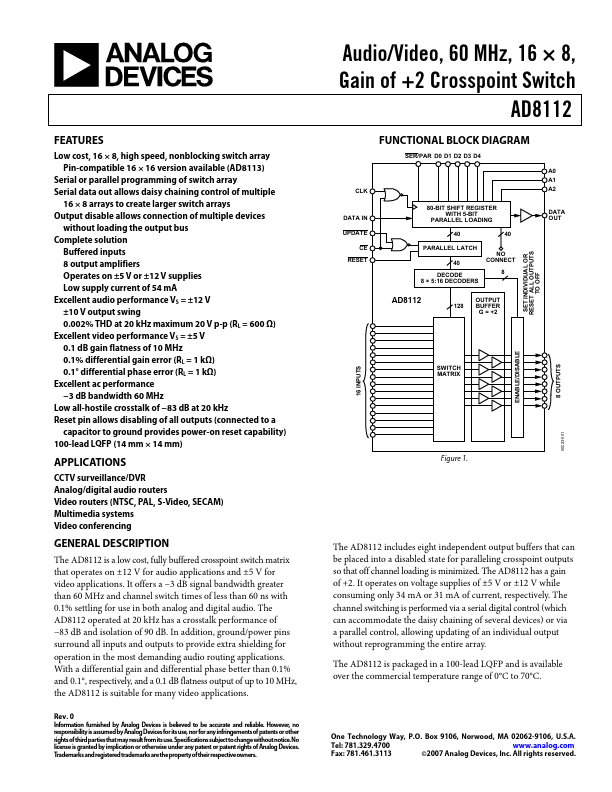
The AD8112 is a low cost, fully buffered crosspoint switch matrix that operates on ±12 V for audio applications and ±5 V for video applications.

3 dB signal bandwidth greater than 60 MHz and channel switch times of less than 60 ns with 0.1% settling for use in both analog and di

Features

  • Low cost, 16 × 8, high speed, nonblocking switch array Pin-compatible 16 × 16 version available (AD8113) Serial or parallel programming of switch array Serial data out allows daisy chaining control of multiple 16 × 8 arrays to create larger switch arrays Output disable allows connection of multiple devices without loading the output bus Complete solution Buffered inputs 8 output amplifiers Operates on ±5 V or ±12 V supplies Low supply current of 54 mA Excellent audio performance VS = ±12 V ±10 V.

📥 Download Datasheet

Datasheet preview – AD8112

Datasheet Details

Part number AD8112
Manufacturer Analog Devices
File Size 725.04 KB
Description fully buffered crosspoint switch matrix that operates
Datasheet download datasheet AD8112 Datasheet
Additional preview pages of the AD8112 datasheet.
Other Datasheets by Analog Devices

Full PDF Text Transcription

Click to expand full text
www.DataSheet4U.com Audio/Video, 60 MHz, 16 × 8, Gain of +2 Crosspoint Switch AD8112 FEATURES Low cost, 16 × 8, high speed, nonblocking switch array Pin-compatible 16 × 16 version available (AD8113) Serial or parallel programming of switch array Serial data out allows daisy chaining control of multiple 16 × 8 arrays to create larger switch arrays Output disable allows connection of multiple devices without loading the output bus Complete solution Buffered inputs 8 output amplifiers Operates on ±5 V or ±12 V supplies Low supply current of 54 mA Excellent audio performance VS = ±12 V ±10 V output swing 0.002% THD at 20 kHz maximum 20 V p-p (RL = 600 Ω) Excellent video performance VS = ±5 V 0.1 dB gain flatness of 10 MHz 0.1% differential gain error (RL = 1 kΩ) 0.
Published: |