AD8221
AD8221 is Precision Instrumentation Amplifier manufactured by Analog Devices.
Precision Instrumentation Amplifier AD8221
Features
Easy to use Available in space-saving MSOP Gain set with 1 external resistor (gain range 1 to 1000) Wide power supply range: ±2.3 V to ±18 V Temperature range for specified performance:
- 40°C to +85°C Operational up to 125°C1 Excellent AC specifications
80 d B minimum CMRR to 10 k Hz (G = 1) 825 k Hz,
- 3 d B bandwidth (G = 1) 2 V/µs slew rate Low noise 8 n V/√Hz, @ 1 k Hz, maximum input voltage noise 0.25 µV p-p input noise (0.1 Hz to 10 Hz) High accuracy dc performance (AD8221BR) 90 d B minimum CMRR (G = 1) 25 µV maximum input offset voltage 0.3 µV/°C maximum input offset drift 0.4 n A maximum input bias current
APPLICATIONS
Weigh scales Industrial process controls Bridge amplifiers Precision data acquisition systems Medical instrumentation Strain gages Transducer interfaces
GENERAL DESCRIPTION
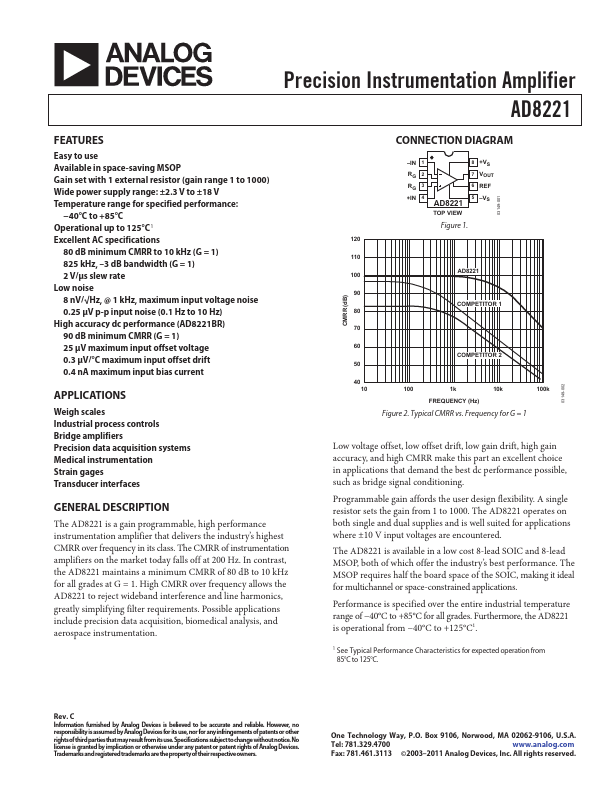
The AD8221 is a gain programmable, high performance instrumentation amplifier that delivers the industry’s highest CMRR over frequency in its class. The CMRR of instrumentation amplifiers on the market today falls off at 200 Hz. In contrast, the AD8221 maintains a minimum CMRR of 80 d B to 10 k Hz for all grades at G = 1. High CMRR over frequency allows the AD8221 to reject wideband interference and line harmonics, greatly simplifying filter requirements. Possible applications include precision data acquisition, biomedical analysis, and aerospace instrumentation.
CONNECTION DIAGRAM
120 110 100
90 80 70 60 50 40
- IN 1 RG 2 RG 3 +IN 4
8 +VS 7 VOUT 6 REF
AD8221 5
- VS
TOP VIEW
Figure 1.
03149-001
AD8221 PETITOR 1
PETITOR 2
100 1k 10k FREQUENCY (Hz)
Figure 2. Typical CMRR vs. Frequency for G = 1
100k
CMRR (d B)
03149-002
Low voltage offset, low offset drift, low gain drift, high gain accuracy, and high CMRR make this part an excellent choice in applications that demand the best dc performance possible, such as bridge signal conditioning.
Programmable gain affords the user design flexibility. A single resistor sets...