AD8322
AD8322 is 5 V CATV Line Driver Coarse Step Output Power Control manufactured by Analog Devices.
a
Features
Supports DOCSIS Standard for Reverse Path Transmission Gain Programmable in 6 d B Steps Over a 42 d B Range Low Distortion at 60 d Bm V Output
- 58 d Bc SFDR at 21 MHz
- 56 d Bc SFDR at 42 MHz Output Noise Level
- 46 d Bm V in 160 k Hz Bandwidth Maintains 75 ⍀ Output Impedance Power-Up and Power-Down Condition 180 MHz Bandwidth 5 V Supply Operation Supports SPI Interfaces APPLICATIONS Gain Programmable Line Driver DOCSIS-pliant Data Modems Interactive Set-Top Boxes PC Plug-in Modems General-Purpose Digitally Controlled Variable Gain Block
5 V CATV Line Driver Coarse Step Output Power Control AD8322
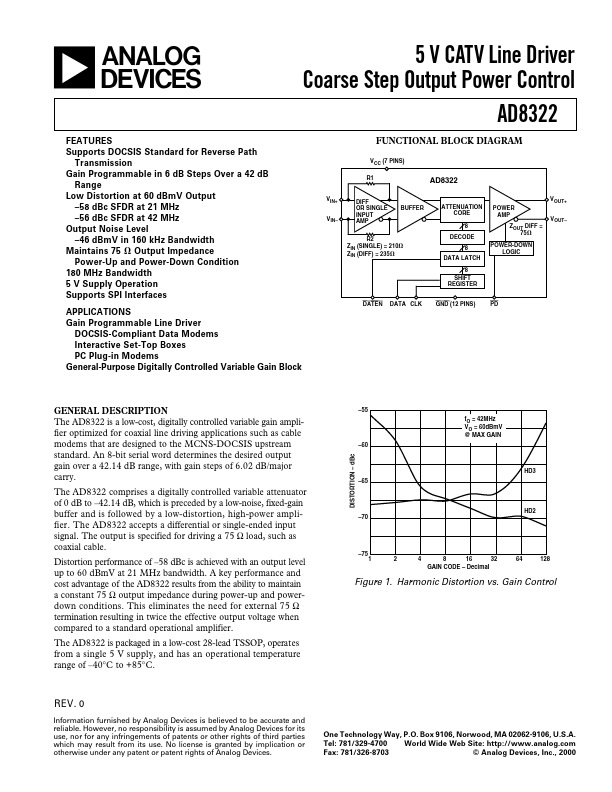
FUNCTIONAL BLOCK DIAGRAM
VCC (7 PINS) R1
VOUT+ BUFFER ATTENUATION CORE 8 DECODE 8 DATA LATCH 8 SHIFT REGISTER POWER AMP ZOUT DIFF = 75⍀ POWER-DOWN LOGIC VOUT-
VIN+ VIN-
DIFF OR SINGLE INPUT AMP
R2 ZIN (SINGLE) = 210⍀ ZIN (DIFF) = 235⍀
DATEN
DATA CLK
GND (12 PINS)
GENERAL DESCRIPTION
- 55 f O = 42MHz VO = 60d Bm V @ MAX GAIN
- 60
DISTORTION
- d Bc
The AD8322 is a low-cost, digitally controlled variable gain amplifier optimized for coaxial line driving applications such as cable modems that are designed to the MCNS-DOCSIS upstream standard. An 8-bit serial word determines the desired output gain over a 42.14 d B range, with gain steps of 6.02 d B/major carry. The AD8322 prises a digitally controlled variable attenuator of 0 d B to
- 42.14 d B, which is preceded by a low-noise, fixed-gain buffer and is followed by a low-distortion, high-power amplifier. The AD8322 accepts a differential or single-ended input signal. The output is specified for driving a 75 Ω load, such as coaxial cable. Distortion performance of
- 58 d Bc is achieved with an output level up to 60 d Bm V at 21 MHz bandwidth. A key performance and cost advantage of the AD8322 results from the ability to maintain a constant 75 Ω output impedance during power-up and powerdown conditions. This eliminates the need for external 75 Ω termination resulting in twice the effective output voltage when...