AD8522
AD8522 is +5 Volt/ Serial Input/ Dual 12-Bit DAC manufactured by Analog Devices.
FEATURES plete Dual 12-Bit DAC No External ponents +5 V Single-Supply Operation ؎10% 4.095 V Full Scale (1 m V/LSB) Buffered Voltage Outputs Low Power: 5 m W/DAC Space Saving 1.5 mm Height SO-14 Package APPLICATIONS Digitally Controlled Calibration Servo Controls Process Control Equipment puter Peripherals Portable Instrumentation Cellular Base Stations Voltage Adjustment
CS CLK CLK LATCH
+5 Volt, Serial Input, Dual 12-Bit DAC AD8522
FUNCTIONAL BLOCK DIAGRAM
VDD DAC A REGISTER D SDI (DATA) SHIFT REGISTER 12 BANDGAP REFERENCE REF BUF VREF REF BUF DAC A 12 OP AMP A VOUTA
D SDO
DAC B REGISTER 12 DAC B OP AMP B VOUTB
LDA LDB
CONTROL LOGIC
MSB RS AGND
DGND
GENERAL DESCRIPTION
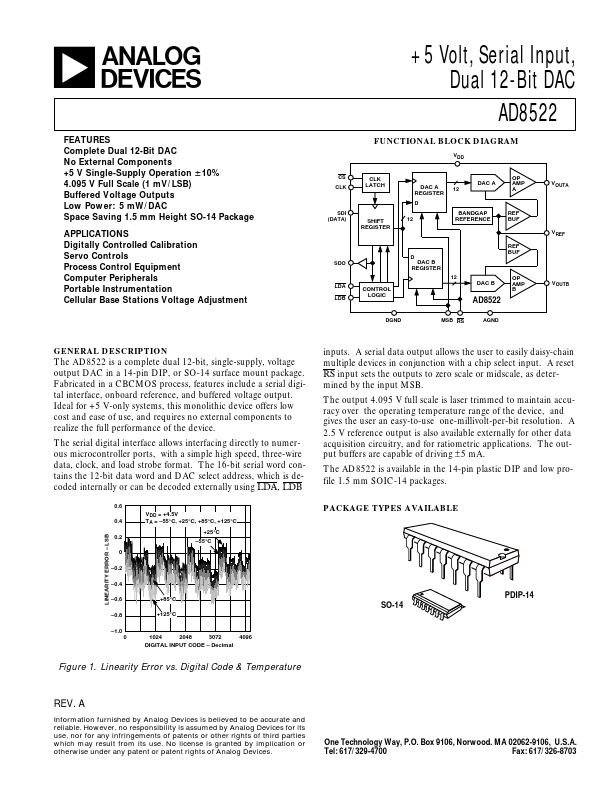
The AD8522 is a plete dual 12-bit, single-supply, voltage output DAC in a 14-pin DIP, or SO-14 surface mount package. Fabricated in a CBCMOS process, features include a serial digital interface, onboard reference, and buffered voltage output. Ideal for +5 V-only systems, this monolithic device offers low cost and ease of use, and requires no external ponents to realize the full performance of the device. The serial digital interface allows interfacing directly to numerous microcontroller ports, with a simple high speed, three-wire data, clock, and load strobe format. The 16-bit serial word contains the 12-bit data word and DAC select address, which is decoded internally or can be decoded externally using LDA, LDB
0.6 0.4
LINEARITY ERROR
- LSB inputs. A serial data output allows the user to easily daisy-chain multiple devices in conjunction with a chip select input. A reset RS input sets the outputs to zero scale or midscale, as determined by the input MSB. The output 4.095 V full scale is laser trimmed to maintain accuracy over the operating temperature range of the device, and gives the user an easy-to-use one-millivolt-per-bit resolution. A 2.5 V reference output is also available externally for other data acquisition circuitry, and for ratiometric applications. The output buffers...