

Datasheet4U Logo Datasheet4U.com

ADG795G - Five-Channel SPDT Switch

This page provides the datasheet information for the ADG795G, a member of the ADG795A Five-Channel SPDT Switch family.

Description

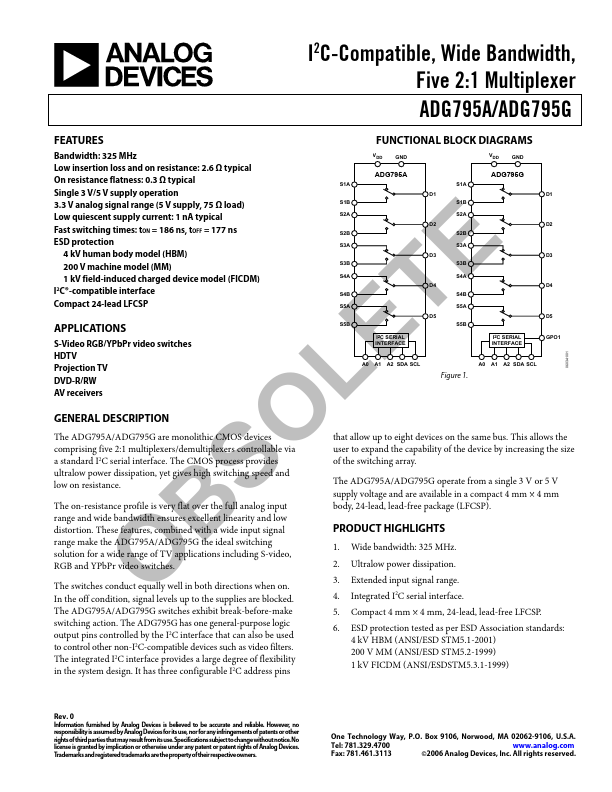
The ADG795A/ADG795G are monolithic CMOS devices comprising five 2:1 multiplexers/demultiplexers controllable via a standard I2C serial interface.

The CMOS process provides ultralow power dissipation, yet gives high switching speed and low on resistance.
Features

  • Bandwidth: 325 MHz Low insertion loss and on resistance: 2.6 Ω typical On resistance flatness: 0.3 Ω typical Single 3 V/5 V supply operation 3.3 V analog signal range (5 V supply, 75 Ω load) Low quiescent supply current: 1 nA typical Fast switching times: tON = 186 ns, tOFF = 177 ns ESD protection 4 kV human body model (HBM) 200 V machine model (MM) 1 kV field-induced charged device model (FICDM) I2C®-compatible interface Compact 24-lead LFCSP.

📥 Download Datasheet

Datasheet preview – ADG795G

Datasheet Details

Part number ADG795G
Manufacturer Analog Devices
File Size 784.92 KB
Description Five-Channel SPDT Switch
Datasheet download datasheet ADG795G Datasheet
Additional preview pages of the ADG795G datasheet.
Other Datasheets by Analog Devices

Full PDF Text Transcription

Click to expand full text
I2C-Compatible, Wide Bandwidth, Five 2:1 Multiplexer ADG795A/ADG795G OBSOLETE 06034-001 FEATURES Bandwidth: 325 MHz Low insertion loss and on resistance: 2.6 Ω typical On resistance flatness: 0.3 Ω typical Single 3 V/5 V supply operation 3.3 V analog signal range (5 V supply, 75 Ω load) Low quiescent supply current: 1 nA typical Fast switching times: tON = 186 ns, tOFF = 177 ns ESD protection 4 kV human body model (HBM) 200 V machine model (MM) 1 kV field-induced charged device model (FICDM) I2C®-compatible interface Compact 24-lead LFCSP APPLICATIONS S-Video RGB/YPbPr video switches HDTV Projection TV DVD-R/RW AV receivers GENERAL DESCRIPTION The ADG795A/ADG795G are monolithic CMOS devices comprising five 2:1 multiplexers/demultiplexers controllable via a standard I2C serial interface.
Published: |