ADMV1013
ADMV1013 is Microwave Upconverter manufactured by Analog Devices.
FEATURES
Wideband RF input frequency range: 24 GHz to 44 GHz 2 upconversion modes
Direct conversion from baseband I/Q to RF Single-sideband upconversion from real IF LO input frequency range: 5.4 GHz to 10.25 GHz LO quadrupler for up to 41 GHz Matched 50 Ω single-ended RF output and IF inputs Option between matched 100 Ω balanced or 50 Ω singleended LO inputs 100 Ω balanced baseband inputs Sideband suppression and carrier feedthrough optimization Variable attenuator for transceiver power control Programmable via 4-wire SPI interface 40-terminal land grid array package (LGA)
APPLICATIONS
Point to point microwave radios Radar, electronic warfare systems Instrumentation, automatic test equipment (ATE)
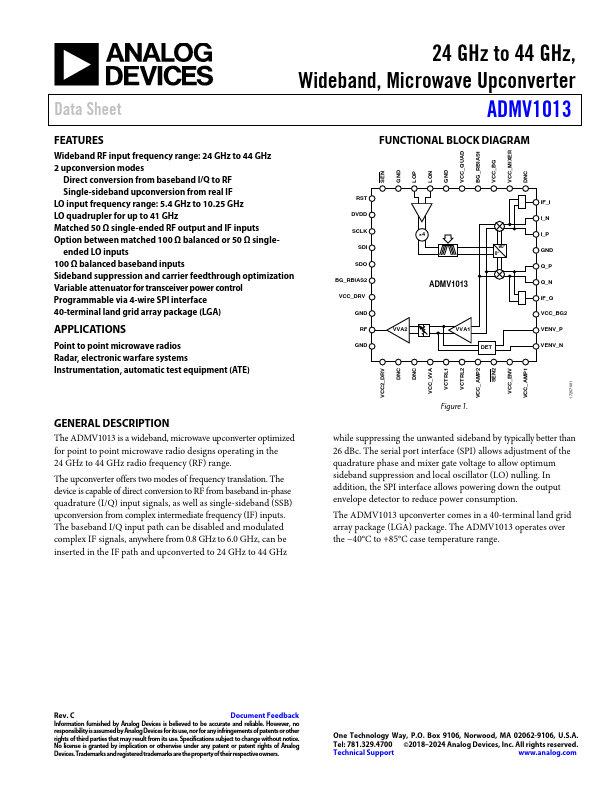
FUNCTIONAL BLOCK DIAGRAM
SEN GND LOP LON GND VCC_QUAD BG_RBIAS1 VCC_BG VCC_MIXER DNC
RST DVDD SCLK
SDI SDO BG_RBIAS2 VCC_DRV GND
RF GND
×4 90°
0°
VVA2
VVA1 DET
IF_I I_N I_P GND Q_P Q_N IF_Q VCC_BG2 VENV_P VENV_N
VCC2_DRV DNC DNC
VCC_VVA VCTRL1 VCTRL2
VCC_AMP2 SEN2
VCC_ENV VCC_AMP1
17267-001
GENERAL DESCRIPTION
The ADMV1013 is a wideband, microwave upconverter optimized for point to point microwave radio designs operating in the 24 GHz to 44 GHz radio frequency (RF) range.
The upconverter offers two modes of frequency translation. The device is capable of direct conversion to RF from baseband in-phase quadrature (I/Q) input signals, as well as single-sideband (SSB) upconversion from plex intermediate frequency (IF) inputs. The baseband I/Q input path can be disabled and modulated plex IF signals, anywhere from 0.8 GHz to 6.0 GHz, can be inserted in the IF path and upconverted to 24 GHz to 44 GHz
Figure 1. while suppressing the unwanted sideband by typically better than 26 d Bc. The serial port interface (SPI) allows adjustment of the quadrature phase and mixer gate voltage to allow optimum sideband suppression and local oscillator (LO) nulling. In addition, the SPI interface allows powering down the output envelope detector to reduce power consumption....